Blog / Orange Park Florida Mazda Service

Mazda OEM Filters vs Aftermarket Options Explained

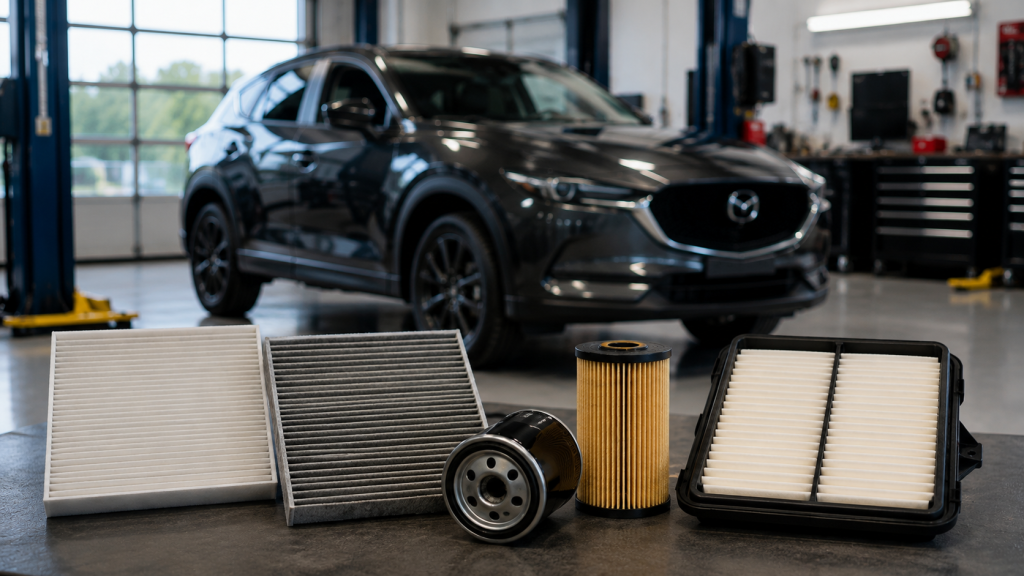
Mazda OEM filters vs aftermarket options becomes an important maintenance question once drivers begin comparing airflow, filtration quality, replacement cost, and long term engine protection. A filter may look simple from the outside, yet it plays a major role in how air, oil, and cabin circulation move through the vehicle. That is why Mazda engineers calibrate filter materials, airflow resistance, and sealing precision around the exact operating characteristics of each model. Whether someone drives a Mazda CX 5 through city traffic or spends long stretches on the highway in a Mazda CX 90, filter quality shapes how smoothly the vehicle breathes, circulates air, and protects internal components over thousands of miles.

Why Mazda OEM Filters Are Engineered Differently

A Mazda OEM filter is built around exact airflow measurements developed during vehicle engineering. That means airflow resistance, filter density, pleat spacing, and sealing pressure are matched to the vehicle’s intake and circulation pathways. Aftermarket options may visually resemble factory parts, though material quality and airflow calibration vary heavily between manufacturers.

Engine air filters influence how air enters the combustion chamber. Modern Mazda engines rely on carefully balanced airflow readings from sensors that monitor oxygen intake and fuel delivery. If airflow restriction changes beyond expected parameters, combustion balance can shift. This may create rougher idle quality, delayed throttle response, or inconsistent airflow readings.

The Mazda CX 50 and Mazda CX 90 both rely on tightly controlled intake management. Air entering the engine passes through multiple monitored stages before combustion begins. Small airflow inconsistencies can create larger operating differences once fuel mapping adjusts around altered intake readings.

Drivers comparing Mazda OEM air filter choices against cheaper aftermarket alternatives should evaluate:

• Filter material density
• Pleat construction consistency
• Seal integrity around housing edges
• Airflow resistance calibration
• Manufacturing consistency between replacement intervals

Lower grade materials sometimes create uneven airflow channels inside the filter surface. When this happens, airflow distribution across the intake pathway becomes less balanced. Mazda engineers calibrate OEM filtration around predictable pressure movement inside the intake assembly, which supports smoother combustion balance over time.

Engine Airflow Stability Shapes How the Vehicle Responds

Engine air filters do more than trap debris. They regulate how evenly air enters the intake pathway before combustion begins. That matters because fuel delivery calculations rely on stable airflow readings. When airflow becomes inconsistent, engine management compensates continuously during acceleration and idle operation.

This becomes easier to notice during stop and go traffic or rapid throttle transitions. A Mazda3 or Mazda CX 5 using a poorly constructed aftermarket filter may still operate normally, though airflow irregularities can slowly influence throttle smoothness and combustion consistency. Drivers sometimes mistake these subtle changes for transmission hesitation or fuel quality variation.

Mazda engineers design OEM intake filters around:

• Air pressure consistency
• Contaminant capture balance
• Sensor airflow calibration
• Stable combustion airflow pathways
• Reduced turbulence entering the intake tract

Aftermarket filters vary widely in filtration structure. Some emphasize lower restriction while sacrificing contaminant capture. Others increase filtration density so heavily that airflow resistance rises faster during normal debris accumulation. Both extremes create airflow differences Mazda did not originally calibrate around.

That becomes more important in turbocharged Mazda models because intake pressure changes influence turbo airflow management more directly. The turbocharged Mazda CX 90 and Mazda CX 70 operate with more tightly controlled intake pressure balancing than naturally aspirated engines.

Mazda Cabin Filter Replacement Influences Interior Airflow

Mazda cabin filter replacement searches continue appearing heavily because drivers notice interior airflow changes long before they see the actual filter. Cabin filters regulate the air circulating through the HVAC assembly before airflow reaches the vents. Dust, pollen, road debris, and moisture particles gradually collect inside the filter material over time.

Once airflow resistance increases, the HVAC blower motor works harder to maintain cabin circulation. Drivers usually notice weaker airflow first during air conditioning operation because colder air becomes more difficult to push through restricted filter material.

A clogged cabin filter may create:

• Slower airflow through dashboard vents
• Increased interior dust circulation
• More strain on HVAC blower operation
• Reduced windshield defrost airflow
• Musty airflow during humid weather

The Mazda CX 5 rear airflow layout places additional importance on interior circulation because rear passenger airflow pathways depend on balanced vent distribution. When cabin airflow weakens, passengers farther from the front vent channels notice the reduction sooner.

Aftermarket cabin filters vary heavily in filtration layering and airflow resistance. Some high density aftermarket materials trap contaminants effectively but reduce airflow earlier during normal accumulation. Mazda OEM cabin filters balance contaminant capture with circulation pressure so airflow remains more stable across the service interval.

Drivers researching Mazda and Apple CarPlay connectivity sometimes mistake weak HVAC airflow for broader climate control problems because airflow strength influences how comfortable the cabin feels during navigation, commuting, and touchscreen interaction.

Oil Filters Protect More Than Oil Cleanliness

Oil filtration discussions stay heavily simplified online, yet oil filters regulate contaminant movement through critical lubrication pathways. Inside the engine, oil continuously circulates through bearings, timing assemblies, camshafts, and turbocharger components. As oil moves through these areas, microscopic debris particles develop naturally from combustion residue and component friction.

The oil filter captures these contaminants before they continue recirculating. Mazda OEM oil filters are engineered around oil pressure flow rates specific to the engine family they support. This includes bypass valve pressure calibration, filter media density, and circulation timing during cold starts.

Cold starts place major stress on oil circulation because thicker oil moves more slowly before reaching operating temperature. If filter restriction rises too quickly, oil pressure changes inside the filter housing may activate the bypass valve sooner than intended. Once bypass operation begins, unfiltered oil circulates through the engine temporarily.

That is why filter construction quality matters beyond basic debris capture.

Mazda OEM oil filters are calibrated around:

• Cold start oil pressure
• Filter media resistance
• Bypass valve activation pressure
• Engine oil circulation timing
• Long term contaminant accumulation patterns

A lower quality aftermarket oil filter may still fit correctly while using thinner filter media or inconsistent internal construction. These differences remain invisible once installed, though long term contaminant circulation patterns inside the engine can gradually shift over higher mileage ownership.

Why Fitment Precision Matters More Than Drivers Expect

One of the least discussed differences between OEM and aftermarket filters involves sealing precision. Filters rely on tight edge sealing to prevent air or oil from bypassing filtration material entirely. Even small inconsistencies around gasket pressure or filter edge dimensions create leakage pathways.

Mazda engineers build OEM filters around exact housing tolerances for models like the Mazda CX 30, Mazda CX 50, and Mazda CX 90. Proper sealing keeps airflow and oil circulation moving through the intended filtration channels instead of around them.

This becomes important because filter bypass leakage is difficult to detect during normal driving. The vehicle may continue operating normally while filtration consistency gradually decreases.

Drivers comparing aftermarket vs OEM filter choices should evaluate more than replacement cost alone. Material quality, airflow stability, sealing precision, and circulation consistency all shape how the vehicle operates over extended maintenance cycles. Mazda engineers calibrate OEM filtration around the complete airflow and lubrication characteristics of each platform, creating a more balanced relationship between filtration protection and smooth operation throughout ownership.


Posted in:

Related Posts

Mazda OEM Battery Replacement vs Aftermarket: Longevity Explained

A Mazda OEM battery replacement decision comes down to specification matching, not brand loyalty. Drivers who understand what the OEM label covers and what aftermarket options must meet will get more service life from every battery they install. The gap between a three-year battery and a six-year battery rarely comes down to price alone. Furthermore, it almost never comes down to the name on the label. What Makes a Mazda Battery Replacement Decision Different Mazda does not manufacture its own batteries. A third-party manufacturer produces the factory battery to Mazda's documented specifications. That distinction matters because the OEM premium pays for specification compliance and warranty coverage. It does not pay for exclusive manufacturing technology. What Mazda controls is the specification itself. Each model carries a documented battery requirement covering group size, cold cranking amps, reserve capacity, and chemistry type. The CX-5 and Mazda3 equipped with i-stop carry different chemistry requirements than models without that system. A battery that meets every number on the spec sheet will perform comparably to the factory unit. Brand source does not change that outcome. more The relevant question is therefore not OEM versus aftermarket. The question is whether the replacement battery matches the documented specifications for your specific model and trim. That evaluation applies equally to both categories. How AGM and Flooded Batteries Differ in Construction and Longevity Car batteries divide into two primary construction types: absorbent glass mat (AGM) and conventional flooded lead-acid. That physical difference determines how long each type lasts under real driving conditions. A flooded lead-acid battery holds electrolyte as a liquid surrounding lead plates inside the case. Budget flooded batteries use plates roughly 1.5 to 1.8mm thick. As the battery cycles through charge and discharge, those plates shed material gradually. Capacity drops measurably after 200 to 300 full cycles. An AGM battery saturates fiberglass mat separators with electrolyte. This construction holds electrolyte in consistent contact with the plates. It also supports thicker plate construction in the same physical case size. Premium AGM batteries typically run plate thicknesses of 2.0 to 2.5mm. As a result, an AGM battery handles 500 to 600 full charge cycles before reaching the same capacity threshold a flooded battery reaches at 200 to 300 cycles. How Driving Patterns Affect Battery Wear Short commutes accelerate battery wear regardless of chemistry. A trip under eight miles rarely gives the alternator enough run time to fully recharge the battery after a cold start. Each short trip leaves the battery in a partial state of charge. Flooded batteries degrade faster under repeated partial-charge conditions because plates sulfate more aggressively when electrolyte concentration stays uneven. AGM construction resists this pattern more effectively. For Mazda drivers with short urban commutes, that construction difference translates directly into service life. What Does the Mazda i-Stop System Require From a Replacement Battery? The i-stop system cuts the engine at traffic stops and restarts it when the driver releases the brake. Each stop-start cycle draws a full cold-start electrical load from the battery. An i-stop-equipped Mazda subjects its battery to far more discharge and recharge cycles per year than a vehicle without that system. A standard flooded lead-acid battery cannot sustain that cycle rate without degrading rapidly. Mazda specifies either an AGM battery or a Q-85 rated battery for every i-stop model. The Q-85 designation indicates a battery built to Japanese Industrial Standard specifications for start-stop applications. It combines AGM construction with a specific case size and terminal configuration compatible with Mazda's battery management sensor. Installing a conventional flooded battery in an i-stop model does not simply shorten battery life. The vehicle's battery management system monitors charge state continuously. It will detect that the installed battery cannot sustain the required cycle depth. In response, the system disables i-stop functionality to protect the battery. The driver loses the fuel efficiency benefit the system provides. The CX-5, Mazda3, Mazda6, and CX-30 equipped with i-stop all require AGM or Q-85 designation for any replacement battery. Chemistry compliance is the requirement. Brand source is not. How to Evaluate Any Replacement Battery Using the Right Metrics Most drivers evaluate batteries by cold cranking amps and price. Cold cranking amps measure the burst current a battery delivers for 30 seconds at zero degrees Fahrenheit. That number governs cold-weather starting power only. It tells you nothing about how long the battery powers vehicle electronics when the engine is off. Reserve capacity governs that scenario. It measures how many minutes a fully charged battery sustains a 25-amp draw before dropping below 10.5 volts. A higher reserve capacity means the battery supports navigation, climate control, and safety electronics longer when the alternator is not running. For any Mazda with driver assistance systems or added accessory loads, reserve capacity matters more than cold cranking amps for everyday reliability. Before purchasing any replacement battery, confirm all four of the following against your owner's manual: Group size must match exactly, because a mismatched group size affects terminal position, hold-down bracket fit, and cable reach, creating installation and vibration issues that shorten battery life regardless of chemistry quality. Cold cranking amp rating must meet or exceed the factory specification for your model, with attention to the difference between Mazda's 2.0-liter and 2.5-liter SKYACTIV variants, which carry different baseline electrical demands. Reserve capacity should meet or exceed 100 minutes for standard Mazda models and 120 minutes for i-stop-equipped models or vehicles carrying accessory loads beyond the factory configuration. Battery chemistry designation must match the factory type, meaning AGM-to-AGM for any model that shipped with AGM from the factory, because downgrading chemistry on a vehicle designed around AGM electrical management creates the same compatibility issues as the wrong group size. A replacement battery clearing all four checkpoints will deliver comparable longevity to the OEM unit regardless of label. What Mazda's Warranty Coverage Means for Non-OEM Battery Choices Dealer content frequently implies that installing a non-Mazda battery puts the vehicle warranty at risk. The legal standard governing this question is more specific than that framing suggests. The Magnuson-Moss Warranty Act prohibits a manufacturer from voiding a vehicle warranty simply because the owner installed a non-OEM replacement part. For a warranty claim to be denied based on a non-OEM battery, the dealer must demonstrate that the aftermarket battery directly caused the specific failure being claimed. A non-OEM battery meeting Mazda's documented specifications cannot be cited as the cause of an unrelated electrical failure or engine management fault. When Battery Selection Can Affect Warranty Coverage The circumstances where battery selection creates warranty exposure are narrow. Installing the wrong battery chemistry in an i-stop model and then filing a warranty claim for battery management system damage creates a direct causal link between the non-compliant part and the failure. Installing a battery with an incorrect group size that damages cable connections creates a similarly direct link. Both involve specification non-compliance, not brand source. A correctly spec-matched aftermarket battery from a reputable manufacturer removes the causal link a dealer would need to deny a claim. The battery label is not the risk. Specification non-compliance is the risk. Understanding that distinction gives every Mazda driver a clear, accurate framework for a replacement decision that serves both their budget and their vehicle's long-term reliability.

How Mazda Diagnostic Fees Work and Warranty Coverage

Mazda diagnostic fee questions usually begin when a warning light appears, a strange sound develops, or a driver receives a repair estimate that includes testing and inspection time. Many drivers understand paying for replacement parts or labor after a repair has been approved, though diagnostic pricing creates more confusion because the vehicle has not been repaired yet. The uncertainty usually centers around one question: what exactly is being paid for during diagnostics? Vehicle diagnostics involve structured testing procedures used to identify root causes before repairs begin. Modern Mazda vehicles rely on integrated electronics, communication modules, sensors, driver assistance technology, and onboard monitoring networks that interact constantly during vehicle operation. Diagnosing concerns inside those systems requires technician expertise, testing equipment, verification procedures, and time spent tracing faults accurately before repairs are approved. What a Mazda Diagnostic Fee Covers What is included in a Mazda diagnostic fee? Diagnostic labor covers the time technicians spend identifying the source of a concern before repairs begin. The process involves much more than connecting a scan tool and reading stored fault codes. A warning light may point toward a broad system category without identifying the exact component responsible for the issue. A check engine light could involve sensor communication faults, fuel delivery irregularities, ignition concerns, vacuum leaks, airflow measurement inconsistencies, or electrical communication interruptions between modules. Technicians usually begin by: more scanning stored fault codes reviewing freeze frame operating data checking sensor communication inspecting visible components performing electrical signal testing duplicating the customer concern during road testing Mazda diagnostic procedures become more detailed when intermittent concerns appear. A problem that only happens occasionally may require repeated testing cycles, temperature variation testing, driving simulation, or signal monitoring over extended periods before the technician confirms the source accurately. This structure matters because replacing parts without proper diagnosis can create unnecessary expense while leaving the original issue unresolved. Accurate diagnostics protect against misdiagnosis by narrowing the repair path through verification instead of assumption. Mazda service pricing reflects the technician time, testing procedures, and inspection structure required to isolate those concerns correctly before repair authorization begins. Why Electrical and Intermittent Problems Take Longer Why can diagnosis sometimes take several hours? Electrical and communication related concerns are frequently more time intensive because the issue may not remain active continuously during inspection. Modern Mazda models use multiple control modules communicating together through onboard data networks. Safety technology, infotainment functions, charging systems, warning lights, sensors, cameras, and engine management systems all exchange information continuously while driving. A technician investigating intermittent electrical concerns may need to: monitor live sensor data trace voltage irregularities inspect wiring continuity verify module communication duplicate startup conditions perform repeated road testing cycles An infotainment issue inside a Mazda CX 5 may only occur after extended driving. A blind spot monitoring warning may appear intermittently depending on weather exposure, sensor contamination, or communication interruptions. Battery related concerns may only develop after overnight sitting conditions or temperature fluctuations. Intermittent problems create frustration because the issue may disappear temporarily before the technician observes it directly. Without duplication and verification, replacing components prematurely may fail to correct the concern completely. Mazda diagnostic procedures prioritize confirmation before replacement. That approach may increase inspection time in some situations, though it reduces the likelihood of unnecessary repairs or unresolved problems returning shortly afterward. How Warranty Coverage Interacts With Diagnostics Are diagnostic fees covered under warranty? Warranty coverage usually depends on what the diagnostic process ultimately confirms. If the technician verifies that a covered component failed within the terms of the Mazda warranty repair coverage period, diagnostic labor may become part of the warranty repair claim. In those situations, the manufacturer may reimburse the dealership for approved diagnostic procedures connected directly to the covered repair. The process changes when: the issue falls outside warranty coverage the concern involves maintenance items outside influence caused the failure no repairable fault is verified aftermarket modifications interfere with diagnosis This distinction creates confusion because drivers sometimes assume all diagnostic testing automatically becomes warranty covered once the vehicle enters the service department. Coverage depends on the verified repair outcome, warranty status, and whether the concern falls within covered repair categories. Mazda service transparency becomes important during this stage because advisors should explain: what testing is being performed whether warranty eligibility is still being verified what may influence coverage decisions whether additional approvals are required how repair authorization proceeds afterward Structured communication reduces confusion because drivers understand the diagnostic process before labor begins. That clarity matters more during electrical diagnosis or intermittent concerns where repair pathways may still be developing during the inspection phase. Why Service Estimates Sometimes Change During Diagnostics Why are estimate updates sometimes necessary? Initial repair estimates are usually based on visible symptoms or preliminary information before deeper testing begins. Once technicians start disassembly, electrical tracing, pressure testing, or component inspection, additional findings may reshape the repair path. A warning light concern initially appearing sensor related may later reveal wiring damage, charging irregularities, or module communication faults after deeper evaluation. A Mazda service advisor may revise the estimate after: additional component failure is discovered electrical tracing reveals secondary issues calibration procedures become necessary repair access requires additional labor supporting components show related wear Estimate adjustments are not automatically signs of inaccurate inspection. Many repair pathways only become fully visible after testing progresses further into the diagnostic sequence. Communication matters heavily during these transitions. Drivers usually respond more positively when updates explain: what new findings appeared why the repair direction changed whether the timeline shifted what repair stages remain how technicians confirmed the updated diagnosis Mazda’s human centered design philosophy extends naturally into ownership communication as well. Drivers want structured explanations that feel calm, understandable, and respectful instead of rushed or overly technical. Why Structured Diagnostics Reduce Repeat Repairs What happens after diagnostics are complete? Once technicians confirm the root cause, repairs move into verification and testing stages before the vehicle returns to the driver. Repair verification matters because fault codes alone do not confirm the issue has been fully resolved. Technicians may clear codes, repeat road testing procedures, monitor system communication again, and confirm warning lights do not return during operation. Verification procedures can include: road testing recalibration procedures sensor communication checks temperature and pressure verification startup cycle testing post repair scan evaluations Structured diagnostics reduce repeat visits because the repair process follows confirmation stages instead of assumption driven part replacement. Drivers may not see these procedures directly, though they shape whether the repair resolves the concern completely the first time. Mazda vehicles are engineered around connected driving feel, smooth communication between driver and vehicle, and balanced system integration. Diagnostic procedures support those same ownership principles by ensuring repairs are verified carefully before the vehicle returns to the road. When drivers understand what diagnostic labor includes, why electrical concerns require additional testing, and how warranty coverage interacts with verified repairs, service pricing becomes easier to understand and far less frustrating. Clear communication transforms diagnostics from an uncertain charge into a structured process built around accuracy, verification, and long term vehicle reliability.