Blog / Orange Park Florida Mazda Dealer

Mazda CX-50 Hybrid vs Honda CR-V Hybrid Daily Use Guide

Mazda CX-50 Hybrid vs Honda CR-V Hybrid Daily Use Guide

Mazda CX-50 Hybrid vs Honda CR-V Hybrid Daily Use Guide

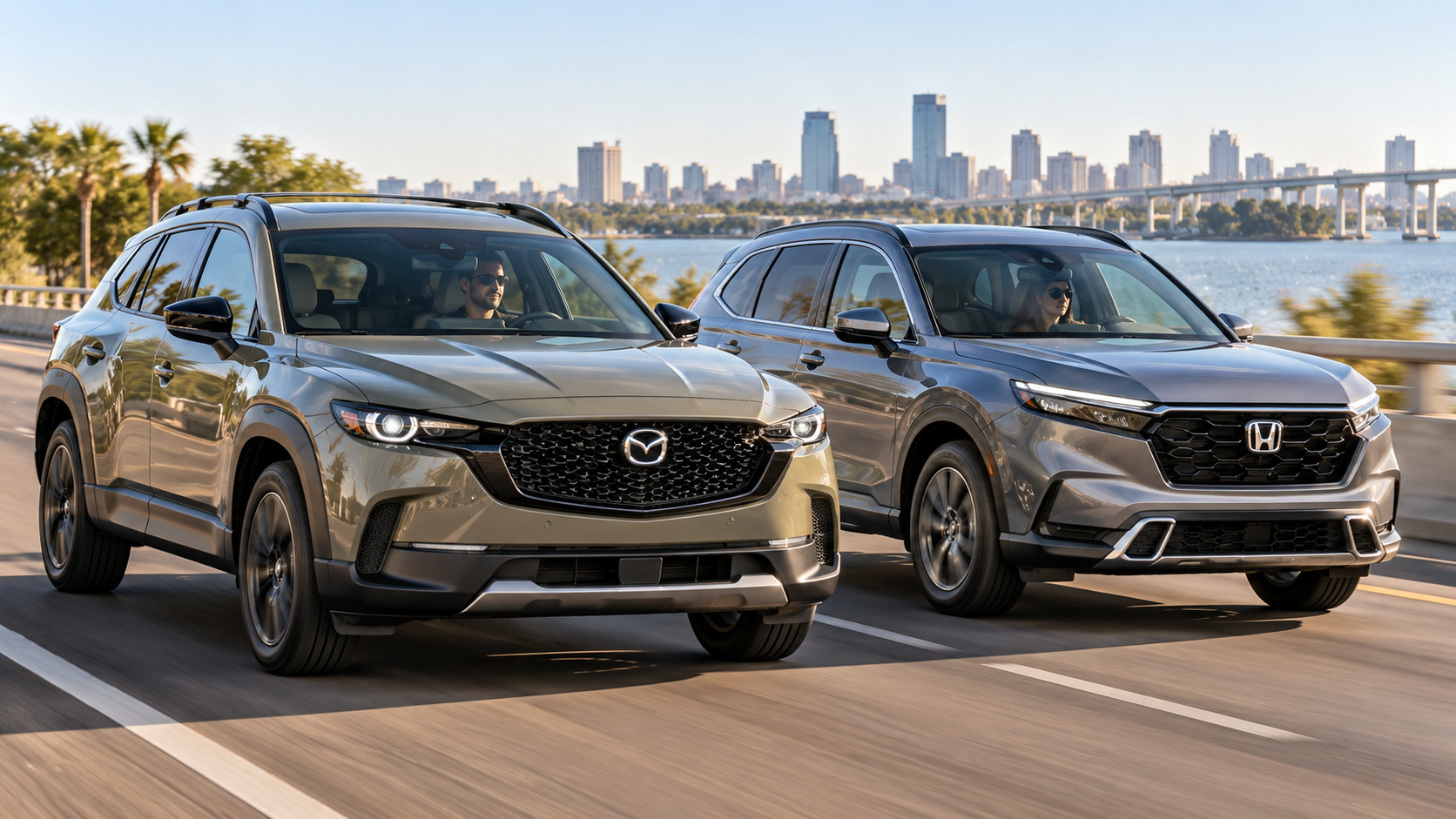
Mazda CX-50 Hybrid vs Honda CR-V Hybrid comparisons involve more than fuel economy. Both compact SUVs pair gasoline engines with electric motors. However, their power, AWD setup, cargo space, and cabin layouts differ.

The right comparison starts with how you plan to drive and carry passengers. Additionally, trim choice matters on the Honda side because AWD and fuel ratings change across the lineup.

Mazda CX-50 Hybrid and Honda CR-V Hybrid Use Different Hybrid Layouts

The CX-50 Hybrid pairs a 2.5 liter four cylinder engine with three electric motors. Together, they produce 219 horsepower. An electronically controlled continuously variable transmission sends power through standard e-AWD.

The CR-V Hybrid uses a two motor hybrid layout with 204 total horsepower. Honda offers front wheel drive on Sport Hybrid. Real Time AWD is available or standard on other hybrid trims.

The main mechanical differences are easier to review when they are separated by category:

  • The Mazda CX-50 Hybrid produces 219 horsepower from its 2.5 liter engine and three electric motor setup.
  • The Honda CR-V Hybrid produces 204 total horsepower from its two motor hybrid system.
  • The Mazda includes e-AWD on every trim, while Honda AWD availability changes by trim.
  • The CX-50 Hybrid includes Power and Trail drive modes across the lineup.

Those specifications create different paths before you even choose cabin features. Therefore, shoppers who want standard AWD have a simpler Mazda trim decision. Honda customers need to confirm drivetrain configuration on the exact CR-V Hybrid trim.

You can review the 2026 Mazda CX-50 lineup at Mazda City before comparing available hybrid trims.

How Does AWD Differ Between the CX-50 Hybrid and CR-V Hybrid?

Every CX-50 Hybrid includes electronic AWD. The layout can direct power between the front and rear wheels as the vehicle operates. Mazda also includes Power and Trail drive modes across all three hybrid trims.

Honda structures AWD differently. Sport Hybrid can use front wheel drive or available Real Time AWD. Sport-L Hybrid also offers AWD. TrailSport Hybrid and Sport Touring Hybrid come with AWD.

Therefore, the Honda trim choice changes both drivetrain and EPA fuel ratings. The Mazda keeps the same basic AWD configuration across Preferred, Premium, and Premium Plus.

During a test drive, compare low speed response and acceleration from a stop. Additionally, try steady cruising and normal turns. These checks give you a better sense of each hybrid layout than horsepower alone.

Passenger Space and Cargo Space Need Separate Evaluation

Cargo figures tell part of the story, but they do not show how your family will load the cabin. Mazda lists 29.2 cubic feet behind the second row. Folding the rear seats opens up 56.3 cubic feet.

The CR-V Hybrid provides more published cargo room. Current specifications list 36.3 cubic feet behind the second row and greater maximum volume with the rear seats folded.

When you compare both SUVs, use the cabin the way you normally would:

  • Set the front seats first, then sit in the second row to check knee room and entry space.
  • Load common bags or larger gear with the rear seats upright before judging the cargo area.
  • Fold the second row and check whether long or bulky items sit securely on the cargo floor.
  • Look at the cargo opening and floor shape because total volume does not explain every loading need.

Still, maximum volume should not replace a physical cargo check. A wide cargo opening can matter with strollers or large boxes. Floor shape also matters when luggage fills most of the rear area.

For this reason, published volume and passenger fit should stay separate in your comparison. One number cannot describe both needs.

Fuel Economy and Technology Change by Driving Pattern and Trim

The CX-50 Hybrid carries EPA estimates of 39 city, 37 highway, and 38 combined MPG. Those ratings remain consistent across the three hybrid trims.

The CR-V Hybrid uses several ratings across its lineup. Front wheel drive Sport Hybrid reaches 43 city, 36 highway, and 40 combined MPG. AWD versions of Sport, Sport-L, and Sport Touring list 40 city, 34 highway, and 37 combined MPG. TrailSport Hybrid carries a separate AWD rating.

That creates several useful fuel economy comparisons:

  • The CX-50 Hybrid posts 39 city, 37 highway, and 38 combined MPG with standard e-AWD.
  • The CR-V Sport Hybrid with front wheel drive reaches 43 city, 36 highway, and 40 combined MPG.
  • Several AWD CR-V Hybrid trims list 40 city, 34 highway, and 37 combined MPG.
  • The TrailSport Hybrid carries lower ratings than the other CR-V Hybrid configurations.

Therefore, your driving mix matters when you read those ratings. The Mazda posts a higher highway figure than several CR-V Hybrid AWD configurations. Honda posts a higher city rating on several trims.

Cabin technology also changes as you move through the lineups. The CX-50 Hybrid includes wireless Apple CarPlay and Android Auto integration. Alexa Built-in is also standard. Higher Mazda trims add features such as Bose audio and additional cabin equipment.

The CR-V Hybrid includes wireless smartphone integration and a 9 inch touchscreen. Higher Honda trims add features such as Bose audio and Google built-in.

What Should You Compare on a Hybrid SUV Test Drive?

A useful test drive should cover the parts of the SUV you will use every week. Start with drivetrain response. Then move through seating, cargo, visibility, and cabin controls.

Use the same checks for both vehicles:

  • Accelerate from a stop and merge onto a faster road to compare hybrid response at different speeds.
  • Check the rear seats after setting the front seats for the people who will drive most often.
  • Open the cargo area and test the items you carry most, including luggage, sports gear, or a stroller.
  • Use the touchscreen, climate controls, and smartphone connection while the vehicle is parked.

Additionally, confirm the exact drivetrain and trim before comparing EPA figures. A CR-V Sport Hybrid with front wheel drive does not share the same ratings as every AWD version.

Mazda City currently lists 2026 CX-50 Hybrid models, including Premium and Premium Plus inventory. You can review current new Mazda inventory before planning your visit.

The Mazda CX-50 Hybrid and Honda CR-V Hybrid approach the compact hybrid SUV category differently. Compare the exact trims, then test passenger fit and cargo space in person. That gives you a clearer basis for choosing the SUV that fits your driving plans.

Posted in:

Related Posts

How Long Do Mazdas Last Maintenance and Used Car Guide

How Long Do Mazdas Last Maintenance and Used Car Guide

How long do Mazdas last when you are comparing a used or certified model? The odometer gives you one piece of the story. Service records, present mechanical state, and past repairs give you more context. Therefore, a higher mileage Mazda should be judged by evidence from the exact car in front of you. A Mazda3 with complete records may deserve a different review than another Mazda3 with missing history. Moreover, the same applies to a CX 5 or another used Mazda. Additionally, mileage should start the evaluation, not finish it. Can Mileage Alone Tell You How Long a Mazda Will Last? No. Mileage alone cannot establish how much service life remains in a specific Mazda. Two cars can show the same odometer reading yet have very different maintenance histories. Therefore, the stronger review combines mileage with records, present mechanical state, and prior repair information. Scheduled service matters because fluids, filters, tires, brakes, and other parts need attention at different intervals. Moreover, those intervals vary by model and model year. The owner manual for the exact Mazda should remain the main maintenance reference. Ask what work has already been completed before you focus on the odometer. A car with documented service gives you more evidence to review. By contrast, missing records create more unknowns that should be checked before purchase. Service Records Show How the Mazda Was Maintained Mazda service records can show when routine work and larger repairs were completed. Additionally, they can show the mileage recorded at each visit. That creates a timeline you can compare with the maintenance schedule for the exact model. When records are available, review several details: Check service dates and odometer readings. Therefore, you can see whether routine work followed a steady pattern. Look for oil and filter records, scheduled maintenance, brake work, tire service, and other completed repairs. Review repair orders and receipts for larger work. That shows which parts were serviced or replaced. Paper records are useful, but dealer records can add another source. Mazda also provides service history tools through MyMazda for eligible records. Therefore, a seller with organized documentation gives you a clearer maintenance trail to review. Still, records do not replace a physical inspection. A receipt shows that work happened on a certain date. Additionally, an inspection tells you how the Mazda is operating now. Mazda3 and CX 5 Evaluation Goes Beyond the Odometer A used Mazda3 or CX 5 should be checked as an individual car. The same odometer reading can sit beside very different tire wear or brake wear. Fluid leaks, warning lights, and prior repairs add more context. Therefore, inspect the exact car you plan to buy. Several areas deserve direct attention during that review: Inspect tire tread, tire wear patterns, and brake response. These items can reveal current service needs. Check for warning lights, fluid leaks, unusual sounds, rough shifting, or steering issues during the drive. Compare the service history with the model specific schedule. This shows whether major maintenance items were completed. For a Mazda3, review records for routine engine service, tires, brakes, and prior repairs. For a CX 5, the same categories matter. In addition, check any service tied to its exact drivetrain and model year. Moreover, a clean interior or polished exterior does not tell you the full mechanical story. Cosmetic care and mechanical care are separate questions. For this reason, use both records and a hands on inspection. What Should You Check Before Buying a Higher Mileage Mazda? Review the service history, present mechanical state, and recall status before you buy. Each source answers a different question. Therefore, using all three gives you a fuller view of the Mazda you are considering. The three checks serve separate roles: A vehicle history report can show documented ownership, accident, title, and repair information from reporting sources. An independent mechanical inspection reviews the car as it sits today. It can uncover issues not shown in a history report. A VIN recall lookup shows whether an unrepaired safety recall is listed for that specific Mazda. A history report should not replace a mechanical inspection. The report looks backward at documented events. By contrast, the inspection looks at present mechanical state. In addition, a recall lookup covers a separate safety question that neither tool fully answers. If a warning light, leak, noise, or drivability issue appears, ask for a closer inspection. The goal is to understand the exact car before you commit to it. Compare Used and Certified Mazdas With Service Records in Hand Once you know what to review, compare the actual cars available to you. Mazda City maintains both used Mazda inventory and Mazda Certified Pre Owned inventory. Moreover, certified models add Mazda program requirements. Ordinary used models should still be judged through records and current inspection findings. For this reason, compare mileage, service history, present mechanical state, equipment, and certification status together. A lower odometer reading does not erase missing records. Likewise, a higher reading does not answer the full question by itself. Mazda City also provides a Mazda service center in Orange Park. Additionally, that gives you a local path for maintenance questions, inspections, and future service planning. How long do Mazdas last is best answered one car at a time. Review the records, inspect the present mechanical state, and check recall status by VIN. Then compare the exact Mazda3, CX 5, used Mazda, or certified model that fits your plans.

Mazda Certified Pre-Owned Warranty and Inspection Guide

Mazda Certified Pre-Owned Warranty and Inspection Guide

Mazda Certified Pre-Owned warranty coverage gives Orange Park customers more structure when reviewing a pre-owned Mazda. Additionally, the program includes a 160-point inspection, roadside assistance, and vehicle history information. Therefore, certified status adds specific Mazda-backed requirements beyond an ordinary used listing. That does not make every used Mazda the same, and it does not make every repair covered. Instead, the CPO program sets a defined inspection and warranty framework for qualifying vehicles. For this reason, it is useful to review each part of the program before choosing a vehicle. What Mazda Certified Pre-Owned Adds to a Used Vehicle A Mazda Certified Pre-Owned vehicle must meet Mazda program requirements before it can receive certification. Moreover, the process combines a factory-trained technician inspection with defined warranty coverage and roadside support. In addition, Mazda provides vehicle history information for each certified vehicle. What does that add beyond an ordinary used Mazda? Therefore, it adds a manufacturer-backed review process and specific coverage terms. However, an ordinary used vehicle can still be a strong choice. Its history, inspection, and current condition should meet your needs. When comparing vehicles, focus on what is included with the exact listing: Certified status means the Mazda completed the required 160-point inspection before being offered under the CPO program. Warranty coverage follows Mazda CPO terms, including separate limited vehicle and limited powertrain coverage periods. Roadside assistance and vehicle history information add more context when you review the vehicle before purchase. Orange Park customers can review current Mazda Certified Pre-Owned inventory at Mazda City. Each listing should be checked for mileage, equipment, warranty status, and certification details. What Does the Mazda 160-Point Inspection Cover? The Mazda 160-point inspection is a multi-area review completed by a factory-trained Mazda technician. It covers major mechanical and physical areas before a vehicle receives CPO certification. Therefore, the inspection is broader than a quick visual walkaround. Mazda identifies several inspection areas within that process: Technicians review engine operation, acceleration, transmission shift quality, and other mechanical checkpoints during the inspection. Brake operation, heating and air conditioning, seats, headrests, and cabin equipment receive separate inspection steps. Exterior items such as windshield condition are also reviewed before the vehicle completes the certification process. Still, the inspection does not mean a CPO vehicle will never need future service. Wear items can still require attention as mileage increases. However, certification confirms that the vehicle completed Mazda's required inspection before sale. For this reason, review the exact certified vehicle instead of relying only on the CPO label. Check mileage, tire condition, brake feel, cabin controls, and the service history that is available. What Mazda CPO Warranty Coverage Do You Receive? Mazda CPO warranty coverage has more than one layer. Additionally, the first layer may be any remaining portion of the original New Vehicle Limited Warranty. After that, Mazda provides additional CPO limited vehicle coverage under current program terms. The main coverage layers are: Any remaining original 3-year or 36,000-mile New Vehicle Limited Warranty continues when it still applies to the vehicle. The CPO Limited Vehicle Warranty adds 12 months or up to 12,000 miles under Mazda program terms. The CPO Limited Powertrain Warranty extends to 7 years or 100,000 miles under Mazda program terms. Additionally, Mazda states that covered CPO repairs have no deductible at Mazda dealers in the United States. The word covered matters here. Routine maintenance and repairs outside the applicable warranty terms are separate from that no-deductible provision. If the original New Vehicle Limited Warranty has already expired, the CPO Limited Vehicle Warranty begins at purchase. Therefore, the exact remaining coverage can differ from one certified vehicle to another. Review the warranty status on the vehicle you are considering. Roadside Assistance and Vehicle History Add More Information Mazda also includes 24-hour emergency roadside assistance during the CPO Limited Powertrain Warranty period. Current Mazda program information lists jump starts, lockout assistance, flat tire changes, towing, and gas delivery. Roadside assistance is separate from warranty repair coverage. It addresses certain roadside events when you need immediate support. By contrast, warranty coverage addresses eligible repairs under the applicable warranty terms. Moreover, vehicle history information adds another layer to the review. Mazda currently states that each CPO vehicle comes with a CARFAX Vehicle History Report. That report documents known prior information, while the 160-point inspection reviews the vehicle's present condition. For this reason, neither item replaces the other. A history report can show past events, while an inspection checks the Mazda in front of you today. Review both before making a final decision. Compare Certified and Ordinary Used Inventory Before Financing By contrast, certified and ordinary used inventory can serve different needs. CPO status adds Mazda program requirements and warranty coverage. An ordinary used vehicle may offer a different price, model year, mileage range, or equipment combination. With that in mind, compare the exact vehicles before moving into financing. Check certification status, mileage, service records, vehicle history, equipment, and remaining warranty coverage. Then review the purchase terms that apply to the vehicle you select. Mazda City maintains both certified Mazda inventory and broader used inventory. Therefore, you can compare certified and ordinary used options within the same dealership inventory. Once you narrow the vehicle choice, review current financing terms separately through the Mazda City finance center. Certification does not guarantee a specific rate or approval result. Instead, the finance process reviews the transaction and applicant information under the available lending terms. A Mazda Certified Pre-Owned warranty package can add useful structure to a pre-owned purchase. The strongest next step is to compare the exact vehicle, inspection status, warranty terms, and history together. From there, compare the final options with your priorities. You can then choose the pre-owned Mazda that fits your plans.

Mazda CX-30

Mazda CX-30 vs CX-5 Comparison for Jacksonville Drivers

Mazda CX-30 vs CX-5 Comparison for Jacksonville Drivers If you have narrowed your next SUV to the Mazda CX-30 and the Mazda CX-5, you are close to the right answer. Both share the same Kodo design language. Both share the same commitment to driver connection. However, they serve different daily routines around Jacksonville, Orange Park, and Middleburg. This guide walks through the Mazda CX-30 vs Mazda CX-5 decision by looking at real space, handling, and trim choices. As a result, you can match the SUV to the way you drive. The Real Size Difference Between the CX-30 and CX-5 The CX-30 is classified as a subcompact crossover. The CX-5 sits one class up as a compact SUV. That single classification shift explains most of what you will notice on a test drive. Additionally, the CX-5 measures several inches longer and wider than the CX-30. It also rides on a longer wheelbase. Because of that extra distance between the front and rear axles, small bumps smooth out before they reach the cabin. By contrast, the CX-30 keeps a tighter footprint. Shoppers driving through Blanding Boulevard traffic or parking near San Marco notice that footprint right away. Even so, neither vehicle gives up Mazda's signature driving feel. The size difference simply shifts where each model shines. Space for Family or Gear Passenger and cargo room scale directly with that size difference. The CX-5 offers more rear legroom than the CX-30. Given that gap, extra room matters most for households carrying adult passengers or kids in booster seats. Still, front-row space stays close between the two models. Because of that, the gap shows up mainly in the back seat and the trunk. Cargo capacity follows the same pattern. The CX-5 holds more behind the rear seats than the CX-30. Furthermore, that gap widens once both rear seats fold flat. A family loading strollers or luggage for a Saint Augustine weekend will feel that extra room, while a single driver running errands around Orange Park may never need it. With that in mind, matching cargo space to your routine keeps the decision grounded in how you use the SUV week to week, instead of chasing the largest number on a spec sheet. Which One Handles Better in Tight Parking and City Streets? The CX-30 earns its reputation among Jacksonville drivers right here. Its shorter length and tighter turning radius make it easier to thread through crowded parking decks and tight neighborhood streets. As a result, drivers who navigate downtown Jacksonville or squeeze into shopping center parking will likely prefer how the CX-30 fits into snug spaces. That said, the CX-5 handles well too, and its available surround-view camera helps offset its larger footprint. Even so, a smaller footprint still wins in the tightest spots. Given that, daily parking convenience can settle the comparison on its own. How Each SUV Feels to Drive Day to Day Both SUVs share Mazda's Jinba Ittai philosophy. That philosophy centers on car and driver feeling like one connected system, built through steering feel, seat position, and pedal response working together. Still, where they differ is weight and road presence. The CX-30's lighter build feels quick and responsive around town. Additionally, available turbocharged power adds real punch when merging onto I-295. By contrast, the CX-5 carries more weight, and that weight translates into a planted feeling at highway speed. Steering response stays sharp in both models. Therefore, this comparison comes down to preference more than a clear technical edge. Drivers who prioritize nimble city driving tend to lean toward the CX-30. On the other hand, drivers who spend more time on longer commutes tend to prefer the CX-5's steadier highway manners. Weighing the Price Difference Against the Extra Size The CX-30 carries a lower starting price than the CX-5. That price gap holds across most comparable trim levels. However, what that difference buys is more than a size step up. Moving to the CX-5 brings additional standard features at each trim tier. Given that, shoppers cross-shopping specific trims should compare feature parity directly. A mid-tier CX-5 trim can sometimes match a higher CX-30 trim's equipment while still delivering the larger footprint. Instead of focusing on the higher price tag alone, weigh whether the extra room fits your driving pattern. Where Can You See These Locally, New or Certified? Mazda City of Orange Park carries current inventory of the new Mazda CX-30 and the new Mazda CX-5. Certified pre-owned options are also available for drivers who want Mazda quality at a lower entry point, with factory-backed inspection standards carried over from the new-vehicle lineup. Test driving both models back to back remains the clearest way to feel the size and handling differences covered here. Driving both on the same familiar roads makes the comparison even clearer. Our team can walk through available trims, current incentives, and financing paths for either SUV, including the newest colors and packages. We can also help match the right model to your daily routine around Jacksonville, Orange Park, Gainesville, or Saint Augustine. With that in mind, whichever direction fits your life better, both the CX-30 and the CX-5 deliver the driving character Mazda is known for.