Blog / Orange Park Florida Mazda Dealer

Blog

All Orange Park Florida Mazda Dealer Mazda City of Orange Park Jacksonville Mazda Dealer Jacksonville Mazda Service Mazda City of Orange Park Service Things To Do In Jacksonville Jacksonville Amenities Jacksonville Entertainment Jacksonville Used Cars Jacksonville Eateries Tom Bush Family of Dealerships Jacksonville Restaurants Jacksonville Parks Jacksonville Landmarks Mazda City of Orange Park Collision Center Mazda SUVs Collision Center in Jacksonville Jacksonville Art Jacksonville Fitness Orange Park Florida Mazda Service Holidays in Jacksonville Shopping in Jacksonville Weekend Getaways Auto Insurance Family Fun in Jacksonville Jacksonville Thrifting Orange Park Mazda Service Road Trips Small Town Fun Things To Do Near Jacksonville
Mazda CX-50 Hybrid vs Honda CR-V Hybrid Daily Use Guide

Mazda CX-50 Hybrid vs Honda CR-V Hybrid Daily Use Guide

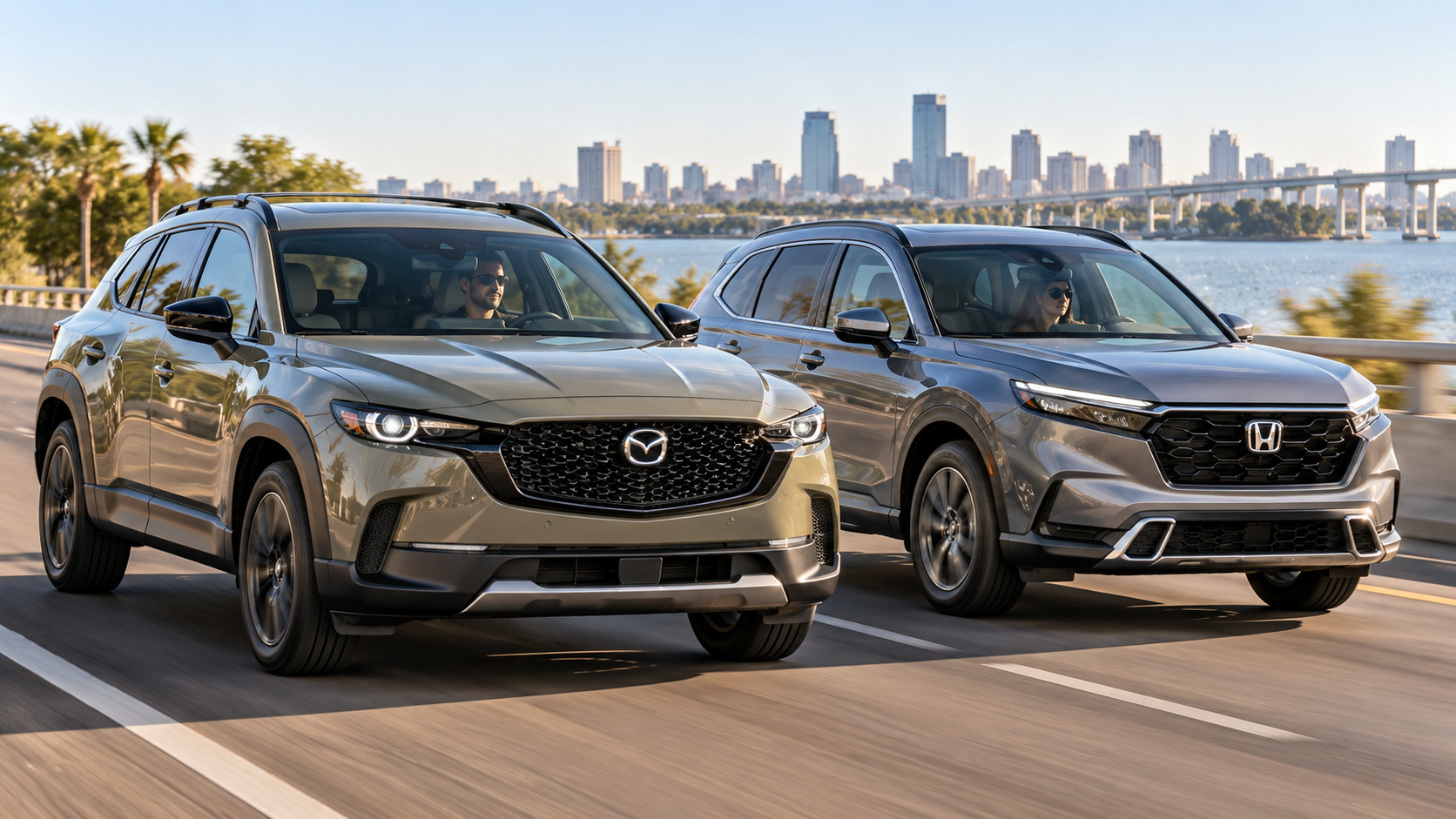
Mazda CX-50 Hybrid vs Honda CR-V Hybrid Daily Use Guide Mazda CX-50 Hybrid vs Honda CR-V Hybrid comparisons involve more than fuel economy. Both compact SUVs pair gasoline engines with electric motors. However, their power, AWD setup, cargo space, and cabin layouts differ. The right comparison starts with how you plan to drive and carry passengers. Additionally, trim choice matters on the Honda side because AWD and fuel ratings change across the lineup. Mazda CX-50 Hybrid and Honda CR-V Hybrid Use Different Hybrid Layouts The CX-50 Hybrid pairs a 2.5 liter four cylinder engine with three electric motors. Together, they produce 219 horsepower. An electronically controlled continuously variable transmission sends power through standard e-AWD. The CR-V Hybrid uses a two motor hybrid layout with 204 total horsepower. Honda offers front wheel drive on Sport Hybrid. Real Time AWD is available or standard on other hybrid trims. The main mechanical differences are easier to review when they are separated by category: The Mazda CX-50 Hybrid produces 219 horsepower from its 2.5 liter engine and three electric motor setup. The Honda CR-V Hybrid produces 204 total horsepower from its two motor hybrid system. The Mazda includes e-AWD on every trim, while Honda AWD availability changes by trim. The CX-50 Hybrid includes Power and Trail drive modes across the lineup. Those specifications create different paths before you even choose cabin features. Therefore, shoppers who want standard AWD have a simpler Mazda trim decision. Honda customers need to confirm drivetrain configuration on the exact CR-V Hybrid trim. You can review the 2026 Mazda CX-50 lineup at Mazda City before comparing available hybrid trims. How Does AWD Differ Between the CX-50 Hybrid and CR-V Hybrid? Every CX-50 Hybrid includes electronic AWD. The layout can direct power between the front and rear wheels as the vehicle operates. Mazda also includes Power and Trail drive modes across all three hybrid trims. Honda structures AWD differently. Sport Hybrid can use front wheel drive or available Real Time AWD. Sport-L Hybrid also offers AWD. TrailSport Hybrid and Sport Touring Hybrid come with AWD. Therefore, the Honda trim choice changes both drivetrain and EPA fuel ratings. The Mazda keeps the same basic AWD configuration across Preferred, Premium, and Premium Plus. During a test drive, compare low speed response and acceleration from a stop. Additionally, try steady cruising and normal turns. These checks give you a better sense of each hybrid layout than horsepower alone. Passenger Space and Cargo Space Need Separate Evaluation Cargo figures tell part of the story, but they do not show how your family will load the cabin. Mazda lists 29.2 cubic feet behind the second row. Folding the rear seats opens up 56.3 cubic feet. The CR-V Hybrid provides more published cargo room. Current specifications list 36.3 cubic feet behind the second row and greater maximum volume with the rear seats folded. When you compare both SUVs, use the cabin the way you normally would: Set the front seats first, then sit in the second row to check knee room and entry space. Load common bags or larger gear with the rear seats upright before judging the cargo area. Fold the second row and check whether long or bulky items sit securely on the cargo floor. Look at the cargo opening and floor shape because total volume does not explain every loading need. Still, maximum volume should not replace a physical cargo check. A wide cargo opening can matter with strollers or large boxes. Floor shape also matters when luggage fills most of the rear area. For this reason, published volume and passenger fit should stay separate in your comparison. One number cannot describe both needs. Fuel Economy and Technology Change by Driving Pattern and Trim The CX-50 Hybrid carries EPA estimates of 39 city, 37 highway, and 38 combined MPG. Those ratings remain consistent across the three hybrid trims. The CR-V Hybrid uses several ratings across its lineup. Front wheel drive Sport Hybrid reaches 43 city, 36 highway, and 40 combined MPG. AWD versions of Sport, Sport-L, and Sport Touring list 40 city, 34 highway, and 37 combined MPG. TrailSport Hybrid carries a separate AWD rating. That creates several useful fuel economy comparisons: The CX-50 Hybrid posts 39 city, 37 highway, and 38 combined MPG with standard e-AWD. The CR-V Sport Hybrid with front wheel drive reaches 43 city, 36 highway, and 40 combined MPG. Several AWD CR-V Hybrid trims list 40 city, 34 highway, and 37 combined MPG. The TrailSport Hybrid carries lower ratings than the other CR-V Hybrid configurations. Therefore, your driving mix matters when you read those ratings. The Mazda posts a higher highway figure than several CR-V Hybrid AWD configurations. Honda posts a higher city rating on several trims. Cabin technology also changes as you move through the lineups. The CX-50 Hybrid includes wireless Apple CarPlay and Android Auto integration. Alexa Built-in is also standard. Higher Mazda trims add features such as Bose audio and additional cabin equipment. The CR-V Hybrid includes wireless smartphone integration and a 9 inch touchscreen. Higher Honda trims add features such as Bose audio and Google built-in. What Should You Compare on a Hybrid SUV Test Drive? A useful test drive should cover the parts of the SUV you will use every week. Start with drivetrain response. Then move through seating, cargo, visibility, and cabin controls. Use the same checks for both vehicles: Accelerate from a stop and merge onto a faster road to compare hybrid response at different speeds. Check the rear seats after setting the front seats for the people who will drive most often. Open the cargo area and test the items you carry most, including luggage, sports gear, or a stroller. Use the touchscreen, climate controls, and smartphone connection while the vehicle is parked. Additionally, confirm the exact drivetrain and trim before comparing EPA figures. A CR-V Sport Hybrid with front wheel drive does not share the same ratings as every AWD version. Mazda City currently lists 2026 CX-50 Hybrid models, including Premium and Premium Plus inventory. You can review current new Mazda inventory before planning your visit. The Mazda CX-50 Hybrid and Honda CR-V Hybrid approach the compact hybrid SUV category differently. Compare the exact trims, then test passenger fit and cargo space in person. That gives you a clearer basis for choosing the SUV that fits your driving plans.

How Long Do Mazdas Last Maintenance and Used Car Guide

How Long Do Mazdas Last Maintenance and Used Car Guide

How long do Mazdas last when you are comparing a used or certified model? The odometer gives you one piece of the story. Service records, present mechanical state, and past repairs give you more context. Therefore, a higher mileage Mazda should be judged by evidence from the exact car in front of you. A Mazda3 with complete records may deserve a different review than another Mazda3 with missing history. Moreover, the same applies to a CX 5 or another used Mazda. Additionally, mileage should start the evaluation, not finish it. Can Mileage Alone Tell You How Long a Mazda Will Last? No. Mileage alone cannot establish how much service life remains in a specific Mazda. Two cars can show the same odometer reading yet have very different maintenance histories. Therefore, the stronger review combines mileage with records, present mechanical state, and prior repair information. Scheduled service matters because fluids, filters, tires, brakes, and other parts need attention at different intervals. Moreover, those intervals vary by model and model year. The owner manual for the exact Mazda should remain the main maintenance reference. Ask what work has already been completed before you focus on the odometer. A car with documented service gives you more evidence to review. By contrast, missing records create more unknowns that should be checked before purchase. Service Records Show How the Mazda Was Maintained Mazda service records can show when routine work and larger repairs were completed. Additionally, they can show the mileage recorded at each visit. That creates a timeline you can compare with the maintenance schedule for the exact model. When records are available, review several details: Check service dates and odometer readings. Therefore, you can see whether routine work followed a steady pattern. Look for oil and filter records, scheduled maintenance, brake work, tire service, and other completed repairs. Review repair orders and receipts for larger work. That shows which parts were serviced or replaced. Paper records are useful, but dealer records can add another source. Mazda also provides service history tools through MyMazda for eligible records. Therefore, a seller with organized documentation gives you a clearer maintenance trail to review. Still, records do not replace a physical inspection. A receipt shows that work happened on a certain date. Additionally, an inspection tells you how the Mazda is operating now. Mazda3 and CX 5 Evaluation Goes Beyond the Odometer A used Mazda3 or CX 5 should be checked as an individual car. The same odometer reading can sit beside very different tire wear or brake wear. Fluid leaks, warning lights, and prior repairs add more context. Therefore, inspect the exact car you plan to buy. Several areas deserve direct attention during that review: Inspect tire tread, tire wear patterns, and brake response. These items can reveal current service needs. Check for warning lights, fluid leaks, unusual sounds, rough shifting, or steering issues during the drive. Compare the service history with the model specific schedule. This shows whether major maintenance items were completed. For a Mazda3, review records for routine engine service, tires, brakes, and prior repairs. For a CX 5, the same categories matter. In addition, check any service tied to its exact drivetrain and model year. Moreover, a clean interior or polished exterior does not tell you the full mechanical story. Cosmetic care and mechanical care are separate questions. For this reason, use both records and a hands on inspection. What Should You Check Before Buying a Higher Mileage Mazda? Review the service history, present mechanical state, and recall status before you buy. Each source answers a different question. Therefore, using all three gives you a fuller view of the Mazda you are considering. The three checks serve separate roles: A vehicle history report can show documented ownership, accident, title, and repair information from reporting sources. An independent mechanical inspection reviews the car as it sits today. It can uncover issues not shown in a history report. A VIN recall lookup shows whether an unrepaired safety recall is listed for that specific Mazda. A history report should not replace a mechanical inspection. The report looks backward at documented events. By contrast, the inspection looks at present mechanical state. In addition, a recall lookup covers a separate safety question that neither tool fully answers. If a warning light, leak, noise, or drivability issue appears, ask for a closer inspection. The goal is to understand the exact car before you commit to it. Compare Used and Certified Mazdas With Service Records in Hand Once you know what to review, compare the actual cars available to you. Mazda City maintains both used Mazda inventory and Mazda Certified Pre Owned inventory. Moreover, certified models add Mazda program requirements. Ordinary used models should still be judged through records and current inspection findings. For this reason, compare mileage, service history, present mechanical state, equipment, and certification status together. A lower odometer reading does not erase missing records. Likewise, a higher reading does not answer the full question by itself. Mazda City also provides a Mazda service center in Orange Park. Additionally, that gives you a local path for maintenance questions, inspections, and future service planning. How long do Mazdas last is best answered one car at a time. Review the records, inspect the present mechanical state, and check recall status by VIN. Then compare the exact Mazda3, CX 5, used Mazda, or certified model that fits your plans.

Mazda Certified Pre-Owned Warranty and Inspection Guide

Mazda Certified Pre-Owned Warranty and Inspection Guide

Mazda Certified Pre-Owned warranty coverage gives Orange Park customers more structure when reviewing a pre-owned Mazda. Additionally, the program includes a 160-point inspection, roadside assistance, and vehicle history information. Therefore, certified status adds specific Mazda-backed requirements beyond an ordinary used listing. That does not make every used Mazda the same, and it does not make every repair covered. Instead, the CPO program sets a defined inspection and warranty framework for qualifying vehicles. For this reason, it is useful to review each part of the program before choosing a vehicle. What Mazda Certified Pre-Owned Adds to a Used Vehicle A Mazda Certified Pre-Owned vehicle must meet Mazda program requirements before it can receive certification. Moreover, the process combines a factory-trained technician inspection with defined warranty coverage and roadside support. In addition, Mazda provides vehicle history information for each certified vehicle. What does that add beyond an ordinary used Mazda? Therefore, it adds a manufacturer-backed review process and specific coverage terms. However, an ordinary used vehicle can still be a strong choice. Its history, inspection, and current condition should meet your needs. When comparing vehicles, focus on what is included with the exact listing: Certified status means the Mazda completed the required 160-point inspection before being offered under the CPO program. Warranty coverage follows Mazda CPO terms, including separate limited vehicle and limited powertrain coverage periods. Roadside assistance and vehicle history information add more context when you review the vehicle before purchase. Orange Park customers can review current Mazda Certified Pre-Owned inventory at Mazda City. Each listing should be checked for mileage, equipment, warranty status, and certification details. What Does the Mazda 160-Point Inspection Cover? The Mazda 160-point inspection is a multi-area review completed by a factory-trained Mazda technician. It covers major mechanical and physical areas before a vehicle receives CPO certification. Therefore, the inspection is broader than a quick visual walkaround. Mazda identifies several inspection areas within that process: Technicians review engine operation, acceleration, transmission shift quality, and other mechanical checkpoints during the inspection. Brake operation, heating and air conditioning, seats, headrests, and cabin equipment receive separate inspection steps. Exterior items such as windshield condition are also reviewed before the vehicle completes the certification process. Still, the inspection does not mean a CPO vehicle will never need future service. Wear items can still require attention as mileage increases. However, certification confirms that the vehicle completed Mazda's required inspection before sale. For this reason, review the exact certified vehicle instead of relying only on the CPO label. Check mileage, tire condition, brake feel, cabin controls, and the service history that is available. What Mazda CPO Warranty Coverage Do You Receive? Mazda CPO warranty coverage has more than one layer. Additionally, the first layer may be any remaining portion of the original New Vehicle Limited Warranty. After that, Mazda provides additional CPO limited vehicle coverage under current program terms. The main coverage layers are: Any remaining original 3-year or 36,000-mile New Vehicle Limited Warranty continues when it still applies to the vehicle. The CPO Limited Vehicle Warranty adds 12 months or up to 12,000 miles under Mazda program terms. The CPO Limited Powertrain Warranty extends to 7 years or 100,000 miles under Mazda program terms. Additionally, Mazda states that covered CPO repairs have no deductible at Mazda dealers in the United States. The word covered matters here. Routine maintenance and repairs outside the applicable warranty terms are separate from that no-deductible provision. If the original New Vehicle Limited Warranty has already expired, the CPO Limited Vehicle Warranty begins at purchase. Therefore, the exact remaining coverage can differ from one certified vehicle to another. Review the warranty status on the vehicle you are considering. Roadside Assistance and Vehicle History Add More Information Mazda also includes 24-hour emergency roadside assistance during the CPO Limited Powertrain Warranty period. Current Mazda program information lists jump starts, lockout assistance, flat tire changes, towing, and gas delivery. Roadside assistance is separate from warranty repair coverage. It addresses certain roadside events when you need immediate support. By contrast, warranty coverage addresses eligible repairs under the applicable warranty terms. Moreover, vehicle history information adds another layer to the review. Mazda currently states that each CPO vehicle comes with a CARFAX Vehicle History Report. That report documents known prior information, while the 160-point inspection reviews the vehicle's present condition. For this reason, neither item replaces the other. A history report can show past events, while an inspection checks the Mazda in front of you today. Review both before making a final decision. Compare Certified and Ordinary Used Inventory Before Financing By contrast, certified and ordinary used inventory can serve different needs. CPO status adds Mazda program requirements and warranty coverage. An ordinary used vehicle may offer a different price, model year, mileage range, or equipment combination. With that in mind, compare the exact vehicles before moving into financing. Check certification status, mileage, service records, vehicle history, equipment, and remaining warranty coverage. Then review the purchase terms that apply to the vehicle you select. Mazda City maintains both certified Mazda inventory and broader used inventory. Therefore, you can compare certified and ordinary used options within the same dealership inventory. Once you narrow the vehicle choice, review current financing terms separately through the Mazda City finance center. Certification does not guarantee a specific rate or approval result. Instead, the finance process reviews the transaction and applicant information under the available lending terms. A Mazda Certified Pre-Owned warranty package can add useful structure to a pre-owned purchase. The strongest next step is to compare the exact vehicle, inspection status, warranty terms, and history together. From there, compare the final options with your priorities. You can then choose the pre-owned Mazda that fits your plans.

Mazda Hybrid and Plug-In Hybrid Models Compared

Mazda Hybrid and Plug-In Hybrid Models Compared

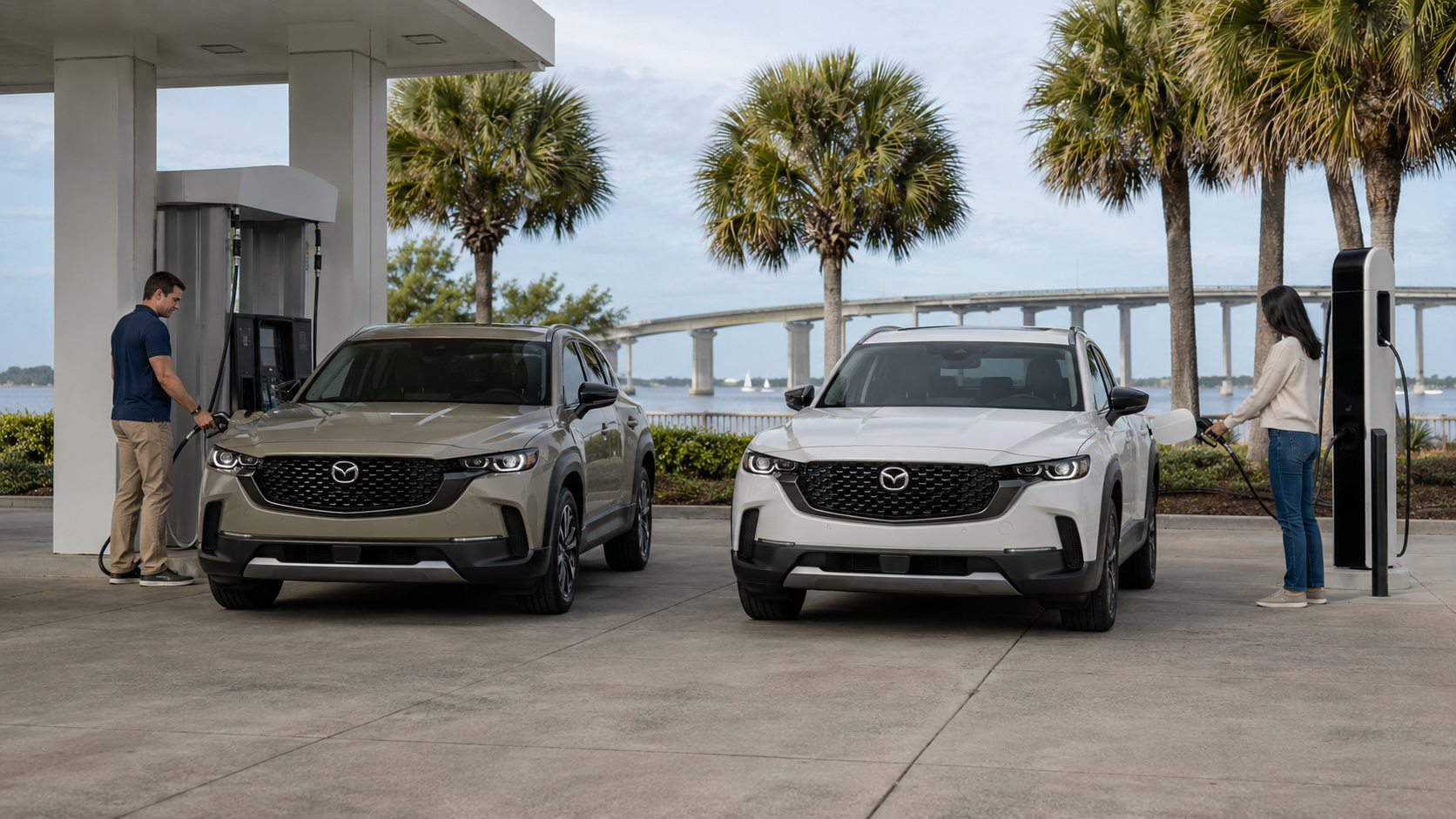
Choosing between Mazda's electrified SUVs comes down to one core question. Do you need to plug in, or does a standard hybrid already fit your routine? The CX-50 Hybrid, CX-70 PHEV, and CX-90 PHEV each take a different approach to efficiency. The right one depends on your daily driving distance, passenger needs, and cargo load. This guide walks through the differences without repeating a full technical breakdown of how hybrid drivetrains work in general. As a result, Jacksonville drivers can match the right electrified Mazda to their routine. Hybrid vs Plug-In Hybrid, Briefly A standard hybrid like the CX-50 Hybrid combines a gas engine with electric motors. Those motors assist automatically, and the vehicle never needs to be plugged in. A plug-in hybrid, on the other hand, like the CX-70 PHEV or CX-90 PHEV, adds a larger battery instead. That battery charges from an outlet and allows genuine electric-only driving before the gas engine takes over. This distinction shapes everything else in this comparison. Consequently, every section below builds on this basic split between plugging in and not. Plugging In or Staying with a Standard Hybrid This question comes down to your daily commute more than any single spec on a window sticker. The CX-50 Hybrid delivers strong combined fuel economy without ever needing a charging cable. Therefore, it suits drivers who want efficiency without changing their routine. The CX-70 PHEV and CX-90 PHEV offer roughly 26 miles of electric-only range on a full charge. For many Jacksonville commutes, that range covers a full round trip on electricity alone. However, that gain only shows up if you plug in on a regular basis. Drivers without consistent access to a home charger may find the CX-50 Hybrid's no-plug simplicity a better fit for daily life. Those who can charge overnight and drive mostly local routes may get real value from the PHEV models instead, since a full charge before bed means starting most mornings on electric power alone. In either case, Mazda's approach to hybrid efficiency stays consistent across the lineup, regardless of which model you choose. Matching the Model to Passenger and Cargo Needs Seating capacity draws a clear line between these three models. The CX-50 Hybrid and CX-70 PHEV both seat five. The CX-90 PHEV, by contrast, adds a third row for up to seven passengers. Cargo space follows a similar pattern as well, since more seating capacity usually means less room dedicated purely to gear. The two-row models offer more room behind the rear seats than the three-row CX-90 PHEV does once all seating is in use. That tradeoff between seating and cargo runs through every trim in the lineup. Here is how the three compare on space. The CX-50 Hybrid offers compact SUV proportions with strong efficiency, suited to daily errands and smaller households. The CX-70 PHEV keeps the same two-row layout with added cargo room, appealing to couples or small families who want extra space without a third row. The CX-90 PHEV adds three-row seating for up to seven, making it the clear choice for larger families or anyone who regularly carries extra passengers. Highway and City Driving Feel All three models keep Mazda's connected driving character. Even so, power output varies from model to model. Consequently, the choice between them usually comes down to how much extra punch you want on tap. Furthermore, that power gap shows up most clearly on the highway, not so much around town. The CX-50 Hybrid delivers smooth, confident acceleration for daily errands and highway merges alike. The CX-70 PHEV and CX-90 PHEV share a hybrid system producing over 320 horsepower combined. As a result, both models feel noticeably quicker than the CX-50 Hybrid. On I-95 or I-295, that extra power translates into easier passing and confident merging. Around town, all three feel composed. Still, the PHEV models carry more weight from their larger batteries. Even so, Mazda's chassis tuning keeps that weight from feeling heavy-handed in daily driving, even at parking-lot speeds. Towing a Trailer or Boat Towing capacity separates these models sharply. The CX-50 Hybrid is built with light-duty needs in mind and is not the choice for serious towing. The CX-70 PHEV and CX-90 PHEV, by contrast, can tow up to 3,500 pounds. That figure covers a small trailer, personal watercraft, or a modest boat, giving both PHEV models real utility beyond daily commuting. For Jacksonville drivers who split time between daily commuting and weekend trips to the water, this towing number frequently becomes the deciding factor. Given that, the choice between the CX-50 Hybrid and the larger PHEV models usually starts right here. Seeing the Lineup in Jacksonville Mazda City of Orange Park carries current inventory of the CX-50 Hybrid, CX-70 PHEV, and CX-90 PHEV. As a result, you get the chance to compare all three side by side before making a decision. Test driving each model back to back remains the clearest way to feel the differences covered here. Power, space, and daily character all come through most clearly behind the wheel. Our team can walk through current trims and financing options. We can also show how each model's efficiency and towing figures line up with your specific routine. Whichever electrified Mazda fits your life best, all three deliver the driving character Mazda is known for. Each one simply wraps that character around a different approach to efficiency.

Mazda CX-5 vs Toyota RAV4 Comparison

Mazda CX-5 vs Toyota RAV4 Comparison for Jacksonville

If you are cross-shopping the Mazda CX-5 vs Toyota RAV4, you are comparing two popular compact SUVs. Both serve Jacksonville drivers well, from daily commutes on I-295 to weekend trips toward the coast. However, they take different paths to get there. This guide walks through space, driving feel, fuel economy, technology, and AWD. As a result, you can match the right SUV to your daily routine around Orange Park and beyond. Passenger and Cargo Space The RAV4 holds an edge in outright cargo volume. It offers more room behind the rear seats than the CX-5. Therefore, families hauling gear for beach trips to Ponte Vedra may lean toward that extra capacity. The same goes for a weekend Costco run. Even so, the CX-5 closed the gap for 2026. Mazda stretched the CX-5's wheelbase by several inches. That change added noticeably more rear legroom, kneeroom, and headroom than the outgoing model offered. As a result, the space comparison is closer than it used to be. The RAV4 still wins on raw cargo numbers, though the gap has narrowed. The differences that matter most for daily use break down like this. The RAV4 offers more maximum cargo volume behind the folded rear seats, which favors larger hauls like furniture or camping gear. The 2026 CX-5's longer wheelbase adds noticeably more rear legroom and kneeroom than the previous generation offered. Rear seat access improved on the CX-5 as well, which matters for parents loading car seats or older passengers climbing in and out at a Jacksonville soccer field. Mazda CX-5 Toyota RAV4 Cargo Space (Behind Rear Seats) 33.7 cu ft 37.8 cu ft Max Cargo Space (Seats Folded) 66.5 cu ft 70.4 cu ft Rear Legroom 39.9 in 37.8 in Towing Capacity 1,500 lbs 1,750 lbs How Each SUV Feels to Drive Day to Day The CX-5 earns its reputation right here. Its steering stays tighter, and body roll stays better controlled. Its six-speed automatic shifts with a crispness that the RAV4's continuously variable transmission cannot fully match. On paper, the RAV4 wins the horsepower and efficiency numbers. Even so, drivers who care about how the SUV feels on I-295 on-ramps tend to prefer the CX-5's connected, driver-focused character. Winding roads toward Middleburg tell the same story, where the CX-5's tighter steering response stays noticeable through every curve. The RAV4 is far from dull, and its 2026 hybrid system delivers smooth, confident power around town. Still, the CX-5 holds the edge for anyone who enjoys the act of driving itself. Fuel Economy and the Hybrid Question This is the RAV4's strongest category, and the gap is real. Every 2026 RAV4 comes standard as a hybrid. That means combined fuel economy sits well above what the CX-5's gas engine returns. Over a full year of Jacksonville commuting, that difference adds up in real fuel savings. However, the CX-5 counters with a lower starting price and standard AWD at no additional cost, two advantages that stand out immediately on a window sticker. Given that, the total value gap narrows even though the CX-5 trails at the pump. A CX-5 hybrid is confirmed for the future, though it will not arrive until the 2027 model year. Given that timeline, shoppers who want a Mazda hybrid today will need to wait. Those focused on driving feel and upfront savings may still find the current CX-5 lineup worth the tradeoff. Technology Worth Using Every Day Both SUVs bring strong technology to the table, though they approach it differently. The CX-5 now offers Mazda's largest center display yet. A completely redesigned interior for 2026 puts that touchscreen front and center. The RAV4 also upgraded its technology, adding a larger available touchscreen and a standard built-in dashcam across every trim. Additionally, wireless Apple CarPlay and Android Auto come standard on both SUVs. As a result, daily phone connectivity feels similar behind the wheel of either one. The bigger difference shows up in interior character. The CX-5 leans toward a driver-focused layout with tactile controls, giving physical dials and buttons to key functions instead of burying them in menus. By contrast, the RAV4 prioritizes straightforward controls that work well without asking much of the driver. Here is how the two lineups compare on the features drivers use most. The CX-5 offers Mazda's largest center display yet, standard on higher trims within its redesigned 2026 interior. The RAV4 includes a standard built-in dashcam on every trim, along with a larger available touchscreen for 2026. Both SUVs include wireless Apple CarPlay and Android Auto as standard equipment, so daily phone connectivity feels similar in either vehicle. Standard AWD and What It Is Worth Every CX-5 trim includes i-Activ AWD at no extra cost. The RAV4, by contrast, starts with front-wheel drive and charges extra for all-wheel drive. For Jacksonville's sudden summer downpours, that standard AWD matters more than it might on drier roads. Once you add the RAV4's AWD cost into the comparison, the price gap between the two SUVs narrows further. That shift favors the CX-5. The RAV4 does produce more horsepower in its hybrid form, so drivers prioritizing outright power may still lean toward Toyota's lineup. Still, for shoppers who want confident traction built into every trim without an upcharge, the CX-5 makes a strong case worth serious consideration. The AWD comparison comes down to a few clear points. Every CX-5 trim includes i-Activ AWD at no additional cost, while RAV4 AWD requires an upgrade from the base front-wheel-drive configuration. Once the RAV4's AWD upcharge is added to its price, the total cost gap between the two SUVs narrows in the CX-5's favor. The RAV4's hybrid powertrain still delivers more horsepower overall, which matters most to drivers who prioritize outright power over standard traction. Mazda CX-5 Toyota RAV4 Base MSRP $29,990 $31,900 Standard Drivetrain i-Activ AWD Front-Wheel Drive AWD-Equipped Price $29,990 $33,300 Combined Horsepower 187 hp 226–236 hp Seeing the CX-5 in Jacksonville Mazda City of Orange Park carries current inventory of the new Mazda CX-5 across multiple trims. That includes both naturally aspirated and available turbocharged configurations. Test driving the CX-5 alongside a RAV4 on the same familiar roads remains the clearest way to feel the differences covered here. Handling, cabin character, and daily comfort all come through on a back-to-back drive. Our team can walk through current CX-5 trims and financing options. We can also show how standard AWD stacks up against RAV4 pricing once Toyota's AWD upcharge is factored in. Whichever direction fits your driving style better, both SUVs represent strong choices for Jacksonville, Orange Park, and the surrounding area. Stopping by for a side-by-side look usually makes the decision clearer than reading specs alone ever could.

Mazda CX-30

Mazda CX-30 vs CX-5 Comparison for Jacksonville Drivers

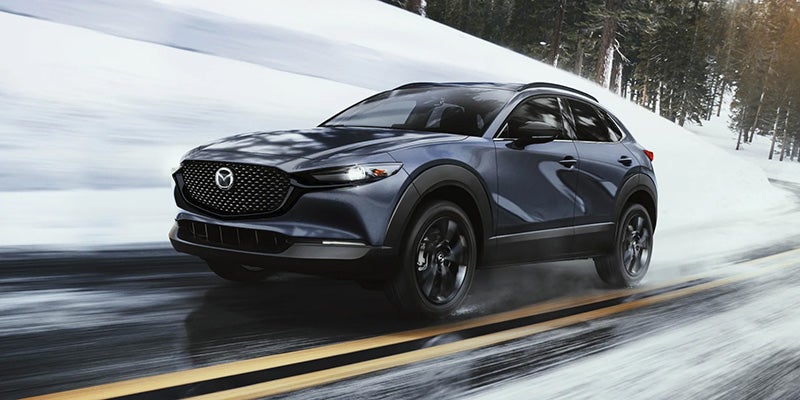
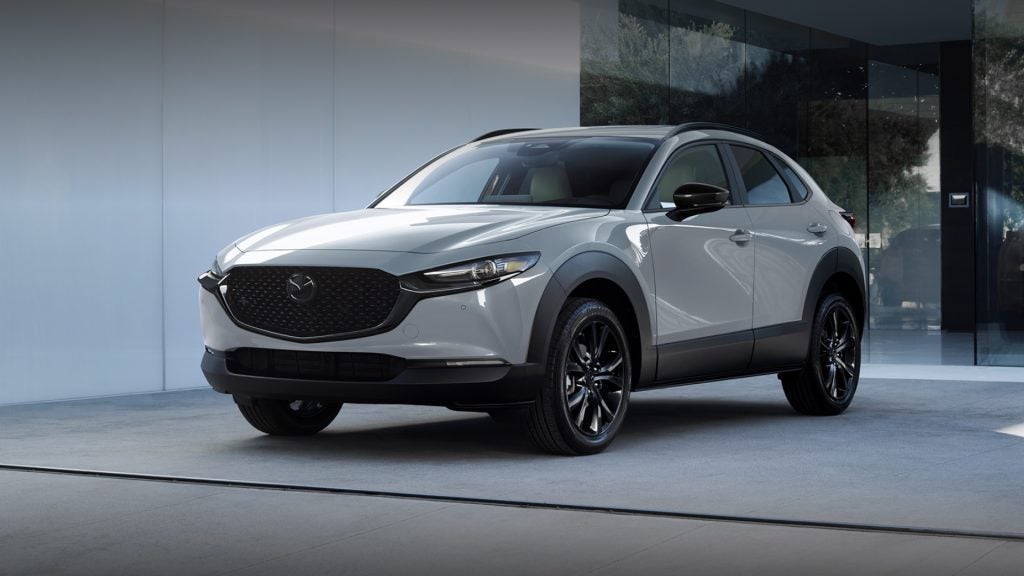
Mazda CX-30 vs CX-5 Comparison for Jacksonville Drivers If you have narrowed your next SUV to the Mazda CX-30 and the Mazda CX-5, you are close to the right answer. Both share the same Kodo design language. Both share the same commitment to driver connection. However, they serve different daily routines around Jacksonville, Orange Park, and Middleburg. This guide walks through the Mazda CX-30 vs Mazda CX-5 decision by looking at real space, handling, and trim choices. As a result, you can match the SUV to the way you drive. The Real Size Difference Between the CX-30 and CX-5 The CX-30 is classified as a subcompact crossover. The CX-5 sits one class up as a compact SUV. That single classification shift explains most of what you will notice on a test drive. Additionally, the CX-5 measures several inches longer and wider than the CX-30. It also rides on a longer wheelbase. Because of that extra distance between the front and rear axles, small bumps smooth out before they reach the cabin. By contrast, the CX-30 keeps a tighter footprint. Shoppers driving through Blanding Boulevard traffic or parking near San Marco notice that footprint right away. Even so, neither vehicle gives up Mazda's signature driving feel. The size difference simply shifts where each model shines. Space for Family or Gear Passenger and cargo room scale directly with that size difference. The CX-5 offers more rear legroom than the CX-30. Given that gap, extra room matters most for households carrying adult passengers or kids in booster seats. Still, front-row space stays close between the two models. Because of that, the gap shows up mainly in the back seat and the trunk. Cargo capacity follows the same pattern. The CX-5 holds more behind the rear seats than the CX-30. Furthermore, that gap widens once both rear seats fold flat. A family loading strollers or luggage for a Saint Augustine weekend will feel that extra room, while a single driver running errands around Orange Park may never need it. With that in mind, matching cargo space to your routine keeps the decision grounded in how you use the SUV week to week, instead of chasing the largest number on a spec sheet. Which One Handles Better in Tight Parking and City Streets? The CX-30 earns its reputation among Jacksonville drivers right here. Its shorter length and tighter turning radius make it easier to thread through crowded parking decks and tight neighborhood streets. As a result, drivers who navigate downtown Jacksonville or squeeze into shopping center parking will likely prefer how the CX-30 fits into snug spaces. That said, the CX-5 handles well too, and its available surround-view camera helps offset its larger footprint. Even so, a smaller footprint still wins in the tightest spots. Given that, daily parking convenience can settle the comparison on its own. How Each SUV Feels to Drive Day to Day Both SUVs share Mazda's Jinba Ittai philosophy. That philosophy centers on car and driver feeling like one connected system, built through steering feel, seat position, and pedal response working together. Still, where they differ is weight and road presence. The CX-30's lighter build feels quick and responsive around town. Additionally, available turbocharged power adds real punch when merging onto I-295. By contrast, the CX-5 carries more weight, and that weight translates into a planted feeling at highway speed. Steering response stays sharp in both models. Therefore, this comparison comes down to preference more than a clear technical edge. Drivers who prioritize nimble city driving tend to lean toward the CX-30. On the other hand, drivers who spend more time on longer commutes tend to prefer the CX-5's steadier highway manners. Weighing the Price Difference Against the Extra Size The CX-30 carries a lower starting price than the CX-5. That price gap holds across most comparable trim levels. However, what that difference buys is more than a size step up. Moving to the CX-5 brings additional standard features at each trim tier. Given that, shoppers cross-shopping specific trims should compare feature parity directly. A mid-tier CX-5 trim can sometimes match a higher CX-30 trim's equipment while still delivering the larger footprint. Instead of focusing on the higher price tag alone, weigh whether the extra room fits your driving pattern. Where Can You See These Locally, New or Certified? Mazda City of Orange Park carries current inventory of the new Mazda CX-30 and the new Mazda CX-5. Certified pre-owned options are also available for drivers who want Mazda quality at a lower entry point, with factory-backed inspection standards carried over from the new-vehicle lineup. Test driving both models back to back remains the clearest way to feel the size and handling differences covered here. Driving both on the same familiar roads makes the comparison even clearer. Our team can walk through available trims, current incentives, and financing paths for either SUV, including the newest colors and packages. We can also help match the right model to your daily routine around Jacksonville, Orange Park, Gainesville, or Saint Augustine. With that in mind, whichever direction fits your life better, both the CX-30 and the CX-5 deliver the driving character Mazda is known for.

2026 Mazda MX-5 Miata vs Mazda3 Hatchback: Driving Engagement Compared

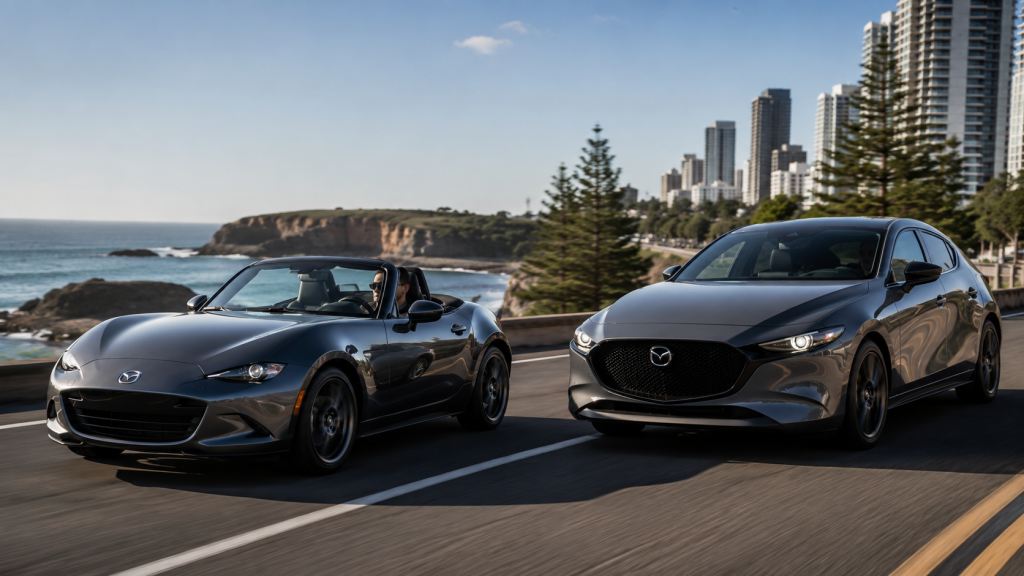
The 2026 Mazda MX-5 Miata vs Mazda3 Hatchback comparison is not a contest between a sports car and a sensible compact. Both vehicles carry Mazda's core engineering philosophy. Both reward a driver who pays attention. However, they deliver that reward through entirely different mechanical approaches. Understanding what each chassis actually does changes how clearly a driver can evaluate which one fits the way they drive. How the Two Chassis Architectures Create Different Engagement Drivetrain layout shapes how a car communicates with its driver more than almost any other single factor. The MX-5 Miata uses a rear-wheel drive layout. The Mazda3 Hatchback uses front-wheel drive, with i-Activ AWD available on upper trims. In a front-wheel drive vehicle, the front tires handle both steering and power delivery at the same time. Under hard acceleration, weight transfers rearward and reduces load on the front axle. That shift creates a mild tug through the steering wheel as the front tires work against the competing demands of turning and driving. The Mazda3's engineers address this through precise chassis tuning and the available AWD system, which distributes torque across all four corners and reduces that front-axle conflict considerably. The MX-5 separates those demands entirely. The front tires steer. The rear tires drive. That division allows each axle to do one job cleanly. Moreover, the rear-drive layout allows the driver to use throttle input to influence the car's cornering attitude in ways a front-drive platform cannot replicate. A driver who trails the throttle into a corner in the MX-5 shifts weight forward, loads the front tires, and sharpens turn-in. That communication runs through the steering wheel, the seat, and the pedals simultaneously. It is the mechanical definition of Jinba Ittai at the chassis level. What the MX-5 Miata's Lightweight Platform Delivers The 2026 MX-5 Miata soft top weighs approximately 2,366 lbs. That number drives the engagement model more than the 181 hp engine does. Low mass changes the felt intensity of every input. A throttle press, a steering correction, a braking point reached slightly late each produces a more immediate and more communicative response than the same input would in a heavier vehicle. The near 50/50 front-to-rear weight distribution reinforces this. Weight sits balanced across both axles at rest. Through a corner, neither end carries disproportionate load. As a result, the car rotates predictably and the driver can place it with confidence. The following specifications define the MX-5's engagement architecture in concrete terms:caranddriver+1 At approximately 2,366 lbs, the soft top MX-5 produces roughly 76 hp per 1,000 lbs of vehicle weight, which places it among the highest power-to-weight ratios in its price class and explains why 181 hp feels far more alive in this chassis than the same output would in a heavier car. The near 50/50 weight distribution means the front and rear axles carry roughly equal load at rest, which allows the suspension to work symmetrically through direction changes and gives the driver consistent feedback from both ends of the car at the same time. The short 90.9-inch wheelbase concentrates the vehicle's mass close to the center of the car, reducing rotational inertia and allowing the chassis to change direction with a quickness that longer-wheelbase vehicles cannot produce regardless of their power output. The RF adds a retractable fastback roof and approximately 100 lbs over the soft top. That modest weight increase preserves nearly all of the soft top's engagement character while adding weather insulation and a quieter cabin at highway speeds. What Does the Mazda3 Hatchback Bring to the Engagement Conversation? The Mazda3 Hatchback is not a car that asks its driver to compromise between engagement and usability. It is a car that delivers both on the same trip. The standard 2.5-liter naturally aspirated engine produces 191 hp. That output moves the Mazda3 with genuine confidence on a two-lane road or a highway on-ramp. The turbocharged variant changes the conversation further. The 2.5-liter turbo produces 250 hp and 320 lb-ft of torque. Paired with i-Activ AWD, it reaches 60 mph in under six seconds. That performance envelope puts the Mazda3 Turbo in legitimate sports compact territory. However, it delivers that performance without the MX-5's physical involvement. The AWD system manages traction distribution electronically. The chassis isolates the driver from the road texture that the MX-5 transmits directly through its structure. How the Mazda3 Hatchback Earns Its Engagement Credentials The Mazda3's engagement comes from a different source than the Miata's. Its steering is precise and well-weighted. The suspension tuning produces a composed, planted feel through corners without the stiffness that often comes with sporty compact setups. G-Vectoring Control runs continuously, making micro-torque adjustments at turn-in that keep weight loaded on the front tires through corners. Beyond that, the 2026 model year refines the cabin materials and driving position further, tightening the connection between driver and car in the way Mazda consistently prioritizes across the lineup. How Jinba Ittai Applies Differently to Each Vehicle Jinba Ittai translates roughly as oneness between horse and rider. Mazda applies it as an engineering target, not a marketing phrase. The goal is a vehicle that responds so naturally to driver inputs that the boundary between person and machine becomes difficult to locate. Both the MX-5 and the Mazda3 pursue that target. They reach it through different paths. The MX-5 pursues Jinba Ittai through physical directness. Low mass reduces the inertia between input and response. Rear-wheel drive separates steering and power delivery so each communicates cleanly. The short wheelbase and balanced weight distribution make the car rotate around the driver rather than requiring the driver to manage a larger, heavier chassis. Every mechanical choice prioritizes the intensity of the connection over the breadth of the car's capabilities. The Mazda3 pursues the same target through refinement and precision. Its steering communicates road surface and cornering load without amplifying harshness. The chassis absorbs road irregularities and returns a stable, predictable platform that a driver can push with confidence. G-Vectoring Control adds a layer of weight-transfer management that makes the car feel more balanced than its front-drive layout would suggest without it. The result is a car where the driver feels competent and in control rather than physically immersed in the road. Neither expression is a lesser version of the other. They reflect two genuinely different answers to the same engineering question. Which Vehicle Fits Which Driver The right choice between these two comes down to how a driver weighs engagement intensity against daily versatility. Both cars reward attention. They reward it differently and they ask different things in return. A driver who prioritizes the physical experience of driving above most other factors, who takes two-lane roads deliberately, and who can manage a two-seat cabin and minimal cargo space in daily life will find the MX-5 irreplaceable. No car at its price point delivers the same level of chassis communication, weight distribution purity, and driver involvement. That experience has a real cost in practicality. A driver who wants genuine driving satisfaction on every commute, the flexibility to carry passengers and cargo, and the option of turbocharged AWD performance in a refined and comfortable daily package will find the Mazda3 Hatchback a more complete answer. It does not provide the MX-5's physical intensity. However, it provides daily engagement without requiring the driver to plan around the limitations of a two-seat roadster. The following questions help clarify which vehicle serves a given driver better: If the driver regularly carries more than one passenger, needs cargo space beyond a weekend bag, or lives in a region with significant winter weather and no secondary vehicle, the Mazda3 Hatchback with i-Activ AWD serves those needs without sacrificing driving engagement on roads that reward a well-tuned compact. If the driver primarily commutes solo, values the physical sensation of driving above passenger comfort or cargo room, and treats backroads and weekend routes as a priority rather than an occasional bonus, the MX-5 Miata delivers an experience that no other vehicle in the Mazda lineup can replicate at any price. Both the MX-5 and the Mazda3 Hatchback represent Mazda's commitment to building cars that move the driver, not just the passengers. The difference is the form that movement takes. One puts the road in your hands. The other puts it beneath your feet. Knowing which sensation you want is the most honest way to choose between them.

Mazda Drive Modes Explained: Efficiency, Comfort, and Control

Mazda drive modes do more than adjust how a car feels. Each mode recalibrates how the vehicle distributes power, shifts gears, and responds to throttle input at a system level. Drivers who understand what changes mechanically with each selection make better decisions about when to switch. Furthermore, they get more from the engineering Mazda built into every model in the lineup. What Mi-Drive Is and How It Works as a System Mi-Drive stands for Mazda intelligent Drive Select. It is the platform that governs drive mode selection across Mazda's current lineup, including the CX-5, CX-50, CX-90, and CX-30. Most drivers think of drive modes as single-variable adjustments. Mi-Drive does not work that way. When a driver selects a mode, Mi-Drive adjusts three vehicle systems at the same time. First, it reprograms the throttle mapping, which changes how the engine responds to pedal input. Second, it adjusts the transmission shift logic, which changes the RPM range the vehicle uses before upshifting. Third, on models equipped with i-Activ AWD, it redistributes torque bias between the front and rear axles to match the selected mode's traction priorities. Each of those three changes affects the others. A sharpened throttle map in Sport mode produces more frequent and more aggressive throttle inputs. Those inputs interact directly with the recalibrated shift logic to hold gears longer. The result is a coordinated shift in how the entire drivetrain behaves, not a single dial turned up. Understanding Mi-Drive as a multi-system calibration tool rather than a preference setting changes how usefully a driver can apply each mode. How Normal Mode Works and When It Serves Drivers Best Normal mode is not a compromise or a factory default that exists because no one selected anything else. Mazda engineers it as the primary calibration for everyday driving. It represents Mazda's most carefully tuned balance between throttle sensitivity, transmission efficiency, and fuel economy across a wide range of road conditions. In Normal mode, the transmission shift mapping prioritizes early upshifts. The Mazda3 and CX-5 with SKYACTIV-G engines shift into higher gears at lower RPMs, keeping the engine in its most fuel-efficient operating range during highway cruising and city traffic. The throttle map is linear, meaning pedal travel translates to engine response proportionally without the amplification Sport mode introduces. Why Normal Mode Rewards Consistent Driving For drivers covering mixed commuting and highway miles, Normal mode consistently returns the best fuel economy figures across the lineup. The early shift behavior reduces engine load during acceleration. Beyond that, the linear throttle map prevents the small, unintentional over-throttle inputs that Sport mode amplifies into more aggressive acceleration. Drivers who cover mostly highway miles or mixed city routes will find Normal mode protects fuel economy without reducing responsiveness in everyday situations. What Does Sport Mode Change and What Does It Not? Sport mode does not add horsepower. The engine produces the same peak output in every mode. What Sport mode changes is how and when that output becomes available to the driver. In Sport mode, Mi-Drive reprograms the throttle map to amplify pedal input. A light press of the accelerator produces a stronger engine response than the same press would generate in Normal mode. At the same time, the transmission holds gears to higher RPMs before upshifting. A CX-5 or Mazda3 in Sport mode will stay in a lower gear through a curve or during an overtake where Normal mode would have already shifted up. That behavior gives the driver access to more torque in the moment without requiring a downshift request. The fuel economy trade-off is direct. Holding higher RPMs and responding more aggressively to throttle inputs increases fuel consumption. The trade-off is smallest at highway speeds where throttle inputs are steady and modest. It is largest in stop-and-go traffic where Sport mode amplifies every small throttle correction into a larger fuel draw. The following changes occur at the system level when Sport mode is active: The throttle map shifts from linear to amplified, meaning a given pedal position produces a larger throttle opening than the same position would in Normal mode, increasing torque delivery at partial throttle. The transmission hold RPM threshold rises, keeping the SKYACTIV-G or SKYACTIV-X engine in its peak torque band longer before the next upshift, which improves in-gear acceleration without requiring a manual downshift. On i-Activ AWD models, the rear axle receives a slightly higher torque bias, which increases drive feel and stability during cornering by loading the rear tires more consistently through acceleration. Sport mode rewards purposeful use. Highway on-ramps, mountain roads, and overtaking situations are where its calibration returns value. City commuting in Sport mode increases fuel consumption without producing a meaningful improvement in how the car moves through traffic. How G-Vectoring Control Works Across All Drive Modes G-Vectoring Control, or GVC, operates independently of Mi-Drive mode selection. It runs continuously in the background across Normal, Sport, and every other available mode. However, its effect on driving feel becomes most noticeable in Sport mode because of how the two systems interact. GVC works by making micro-reductions to engine torque at the moment a driver turns the steering wheel. That brief torque reduction shifts a small amount of weight onto the front tires at turn-in. With more load on the front axle, the tires generate more cornering grip at the precise moment the driver needs steering response. As the driver unwinds the wheel at corner exit, GVC restores torque smoothly, which transfers weight back toward the rear and stabilizes the car under acceleration. In Normal mode, GVC operates on relatively small and gradual throttle inputs. Its torque adjustments are modest and the transitions stay smooth. In Sport mode, the amplified throttle map produces sharper and more frequent torque changes. GVC responds to each of those changes, making its weight transfer adjustments more active throughout a corner. The result is that Sport mode and GVC work together to sharpen steering response and body control simultaneously. Drivers who notice that the CX-5 or Mazda3 feels more planted and responsive in Sport mode during corners are experiencing GVC and Mi-Drive operating in coordination. Off-Road and Towing Modes: What Changes at the System Level Off-Road and Towing modes address specific driving scenarios that Normal and Sport modes are not calibrated for. Both are available on select Mi-Drive-equipped models including the CX-50, CX-90, and CX-70. Off-Road mode raises the traction control intervention threshold. In Normal mode, the traction control system responds quickly to wheel slip and reduces torque to restore grip. That fast intervention works well on paved surfaces. On loose gravel, sand, or snow, a small amount of wheel slip is productive because it allows the tires to dig into the surface. Off-Road mode tells the traction control system to allow more slip before intervening. At the same time, i-Activ AWD shifts torque rearward and distributes it more evenly across all four corners. The throttle map becomes more progressive, reducing the chance of sudden torque spikes that break traction on loose surfaces. Towing mode addresses a different set of demands. A loaded trailer changes the vehicle's weight distribution, braking distance, and transmission heat load. Towing mode recalibrates the transmission shift logic to hold lower gears longer, which reduces the frequency of hunting between gears on grades. It also adjusts AWD torque distribution to account for the added rear weight from the trailer hitch load. The following changes occur when Off-Road or Towing mode is active: Off-Road mode raises the traction control slip threshold and shifts AWD torque toward a more even four-corner distribution, allowing productive wheel slip on loose surfaces while maintaining directional stability through the AWD system. Towing mode recalibrates transmission shift points to reduce gear hunting on inclines and adjusts AWD torque bias rearward to compensate for trailer tongue weight pressing down on the hitch. Both modes return the vehicle to its standard calibrations the moment Normal or Sport is selected again. Neither mode modifies any permanent vehicle setting. Drivers with CX-50 or CX-90 models covering gravel roads, boat launches, or mountain grades will find that selecting the correct specialized mode produces measurably more stable and controlled vehicle behavior than leaving the vehicle in Normal mode for those specific scenarios.

CX 5 vs CX 50 Hybrid: Efficiency, Space, Driving Feel

CX 5 vs CX 50 Hybrid comparisons usually begin with fuel economy, though cargo space, powertrain feel, cabin layout, and daily driving rhythm shape the larger decision. These two Mazda SUVs overlap heavily in size and purpose, which creates confusion for shoppers narrowing their options. Both support all wheel drive confidence, passenger comfort, and Mazda’s connected steering philosophy, yet they approach those goals through different powertrain and packaging strategies. The Mazda CX 5 continues using a traditional gas powered setup focused on smooth throttle response, balanced ride comfort, and familiar acceleration delivery. The Mazda CX 50 Hybrid introduces electric motor assistance and hybrid energy management to reduce fuel use during commuting and lower speed driving. While the dimensions appear close on paper, the ownership feel changes once these SUVs are driven back to back. Hybrid Efficiency Versus Traditional Gas Power Is the CX 50 Hybrid more efficient than the CX 5? The CX 50 Hybrid uses a hybrid powertrain that combines a gasoline engine with electric motor support. During slower driving, stoplights, and lower speed traffic movement, the electric motor assists propulsion and reduces how heavily the gasoline engine needs to work. That changes fuel use patterns most noticeably during: stop and go commuting suburban traffic movement lower speed errands repeated acceleration cycles city driving with frequent slowing The hybrid setup continuously shifts energy between regenerative braking, battery support, and gasoline operation. When the driver lifts off the accelerator or brakes, energy is redirected back into the battery system instead of being lost entirely through heat during braking. The Mazda CX 5 uses a more traditional powertrain structure with direct gasoline engine response. Acceleration feels linear and immediate because throttle response comes directly from engine output instead of transitioning between electric assist and gasoline support. Some drivers prefer this because: acceleration feels more familiar engine response remains predictable highway merging feels more direct throttle modulation stays consistent engine sound and speed remain connected The CX 50 Hybrid delivers stronger efficiency during traffic heavy commuting while the CX 5 maintains a more traditional Mazda driving character. Neither approach is automatically better. The difference depends heavily on where and how the SUV spends most of its time. Cargo Space and Cabin Layout Feel Different in Use Which Mazda SUV has more usable cargo space? Cargo measurements alone rarely explain how an SUV feels during loading and passenger use. Rear hatch opening width, floor height, seat folding shape, and passenger layout influence how usable the space feels once luggage, groceries, sports gear, or travel equipment enter the picture. The Mazda CX 5 focuses heavily on balanced passenger and cargo packaging. Rear passengers sit in a cabin that feels slightly more enclosed and comfort focused while the cargo area maintains strong loading flexibility behind the second row. The CX 50 Hybrid introduces a wider visual stance and more rugged cargo presentation. The rear cargo opening feels broader visually while the overall body structure emphasizes outdoor travel and active use styling. Cargo usability differences become noticeable during: grocery loading luggage stacking pet crate placement sports equipment storage stroller loading rear seat folding transitions The Mazda CX 5 cargo layout feels more traditionally organized while the CX 50 Hybrid leans toward an open and adventure focused presentation. Drivers who prioritize interior comfort and cleaner cabin integration may lean toward the CX 5. Drivers carrying larger outdoor equipment or road trip gear may appreciate the broader visual layout of the hybrid model. Rear passenger movement matters as well. Family shoppers should evaluate: rear door opening size rear seat access cargo floor height child seat loading movement rear visibility while parking These details shape daily ownership much more than specification charts alone. Steering Feel and All Wheel Drive Character Which Mazda SUV feels easier to drive every day? Mazda tuning philosophy centers around steering precision, body control, and natural driver connection. Both SUVs reflect that philosophy, though their personalities separate once the road begins changing direction or traffic density increases. The Mazda CX 5 maintains a slightly lower feeling body posture and a smoother transition between steering inputs. The gas powertrain contributes to a more connected acceleration relationship because throttle response remains mechanically direct. The CX 50 Hybrid changes the driving rhythm slightly through: electric motor torque delivery hybrid braking transitions different weight distribution regenerative braking interaction altered acceleration pacing Electric motor assistance creates quicker low speed torque delivery from stops. During slower traffic movement, the SUV responds smoothly and quietly because the electric motor supplements early acceleration before the gasoline engine increases workload. Mazda all wheel drive tuning also shapes how these SUVs feel through corners and changing road surfaces. Both vehicles monitor wheel slip, steering angle, throttle position, and traction demands continuously. Torque distribution shifts proactively instead of waiting for substantial wheel slip to develop first. Drivers comparing the two should evaluate: steering weight braking smoothness parking visibility highway stability acceleration feel from stoplights body movement during lane changes The CX 5 preserves a more traditional connected driving feel while the CX 50 Hybrid introduces smoother low speed efficiency oriented movement. Commuting, Road Trips, and Family Fit Which SUV fits commuting and road trips better? The answer depends heavily on mileage patterns, passenger routines, and cargo expectations. The Mazda CX 50 Hybrid fits strongly into: heavy commuting schedules urban traffic movement fuel conscious driving longer stop and go routes lower speed suburban travel Drivers spending large amounts of time in traffic may notice fuel savings more substantially because hybrid systems gain the most advantage during repeated slowing and acceleration. The Mazda CX 5 remains strong for: balanced family driving highway travel traditional gas SUV familiarity smoother throttle response comfort focused commuting Highway focused drivers may notice the efficiency gap narrows somewhat once speeds remain more constant for longer periods. Hybrid systems create their largest efficiency advantages during lower speed traffic patterns where regenerative braking and electric assist remain active more frequently. Family shoppers should also evaluate: rear passenger comfort cargo organization highway seat comfort visibility during parking infotainment layout Apple CarPlay integration visibility Mazda structures interior technology carefully across both SUVs so navigation, climate controls, and media interaction remain visually clean and easier to manage during driving. Which Mazda SUV Fits Your Priorities Better What should shoppers evaluate before choosing between the two? The strongest comparison point is not simply hybrid versus gas power. The larger question involves how the SUV will spend most of its life. Drivers prioritizing commuting efficiency, stop and go traffic reduction, and lower speed fuel savings may lean naturally toward the Mazda CX 50 Hybrid. The electrified powertrain changes how the SUV responds during traffic while supporting stronger fuel efficiency during urban movement. Drivers prioritizing smoother traditional acceleration feel, comfort focused driving rhythm, and familiar gasoline response may prefer the Mazda CX 5. The vehicle maintains Mazda’s connected steering feel while balancing passenger comfort and cargo flexibility in a cleaner and more familiar package. Both SUVs continue reflecting Mazda’s human centered engineering philosophy through: balanced steering calibration intuitive cabin layouts driver centered visibility controlled body movement measured technology integration The CX 50 Hybrid expands Mazda’s electrified SUV direction while the CX 5 continues delivering one of the most recognizable driving personalities in the compact SUV segment. The better fit comes from understanding how your commute, cargo needs, passenger routines, and driving priorities intersect with the strengths each SUV delivers daily.

Understanding Mazda i Activsense Safety Technology

Mazda i Activsense features are built to support awareness during the small driving moments that happen every day, from highway merging to crowded parking lots. The technology inside these driver assistance features is not meant to overpower the person behind the wheel or create constant interruptions. Mazda approaches safety through support and connection, shaping technology around natural movement and driver awareness instead of aggressive intervention. That philosophy reflects Mazda’s human centered design approach, where technology exists to work with the driver in a calm and intuitive way. Modern Mazda vehicles such as the Mazda CX 5 and Mazda CX 90 use cameras, radar sensors, steering inputs, and braking communication to monitor traffic movement around the vehicle continuously. While these features sound highly technical on paper, most drivers notice them through subtle moments. A warning light appears beside the mirror during a lane change. The steering wheel gently responds near a lane edge. The vehicle adjusts following distance during traffic flow. These interactions are intentionally smooth so the technology feels supportive instead of distracting. How Mazda i Activsense Uses Cameras and Radar Together What does Mazda i Activsense do? Mazda i Activsense is a collection of driver awareness features that monitor surrounding traffic, lane positioning, vehicle spacing, and potential collision risks through coordinated sensor communication. Different sensors perform different jobs. Cameras mounted near the windshield monitor lane markings, road positioning, and object recognition. Radar sensors monitor traffic speed and surrounding vehicle movement. The vehicle’s onboard processing system combines these inputs continuously while driving. A Mazda CX 90 traveling through highway traffic may use: Forward radar to measure following distance Cameras to monitor lane positioning Steering sensors to evaluate driver inputs Brake system communication to prepare intervention timing Speed monitoring to calculate traffic pacing These features work together instead of operating independently. When adaptive cruise control adjusts following distance, the vehicle is simultaneously evaluating lane positioning, traffic speed changes, and steering inputs. Mazda calibrates these interactions carefully so the vehicle responds naturally without abrupt reactions. That smoother calibration changes how the technology feels during commuting. Some driver assistance systems from other manufacturers interrupt the drive aggressively through loud warnings or sudden corrections. Mazda focuses on gradual awareness support that blends into normal driving rhythm more naturally. Blind Spot Monitoring and Rear Traffic Awareness During City Driving How does blind spot monitoring work? Blind spot monitoring uses radar sensors positioned near the rear corners of the vehicle to detect traffic moving beside or approaching the Mazda from neighboring lanes. When another vehicle enters the monitored zone, an indicator appears near the side mirror. If the driver activates a turn signal while traffic remains inside the monitored area, the system increases the alert through visual and audible warnings. The Mazda CX 5 rear visibility layout already provides strong outward visibility through thoughtful design proportions and window placement. Blind spot monitoring adds another layer of awareness by detecting movement outside direct sightlines during lane changes and merging situations. Rear cross traffic alert expands this awareness further while backing out of parking spaces. Parking lots create difficult visibility angles because larger vehicles, shopping carts, landscaping barriers, and traffic movement block clear sightlines behind the vehicle. Rear traffic monitoring helps detect: Crossing vehicle movement Approaching traffic from side aisles Movement hidden behind larger vehicles Traffic approaching outside mirror visibility Motion during low speed reversing Radar sensors scan side to side movement behind the vehicle while reversing. If approaching traffic enters the monitored zone, the system alerts the driver before the crossing vehicle becomes fully visible through the rear camera or mirrors. These alerts matter most during crowded parking situations where traffic movement changes rapidly and visibility disappears quickly between parked vehicles. Adaptive Cruise Control Changes Highway Driving Rhythm How does adaptive cruise control react to traffic? Adaptive cruise control monitors the distance between the Mazda and vehicles ahead while automatically adjusting speed to maintain selected spacing. Traditional cruise control maintains fixed speed regardless of surrounding traffic. Adaptive cruise control adds traffic awareness by calculating distance and closing speed continuously through forward radar monitoring. A Mazda CX 90 driving through highway congestion evaluates: Vehicle speed ahead Closing distance rate Traffic slowdown patterns Lane movement changes Acceleration pacing When traffic slows, the system reduces throttle input gradually and may apply braking pressure smoothly to preserve spacing. Once traffic begins moving again, acceleration returns progressively toward the selected cruising speed. Mazda calibrates acceleration and braking transitions carefully because abrupt speed changes create discomfort and tension during longer highway drives. The goal is not automation for its own sake. The goal is maintaining a smoother driving rhythm that reduces constant throttle and brake adjustments during traffic flow. This becomes noticeable during: Stop and go traffic Long highway commutes Multi lane traffic pacing Gradual traffic slowdowns Highway construction merging The technology still expects driver engagement. Steering input, awareness, and surrounding traffic evaluation remain centered around the driver. Mazda positions these features as assistance tools supporting awareness instead of replacing driver involvement entirely. Lane Departure Systems Support Steering Awareness Does Mazda steering assist take over driving? Lane departure systems support steering awareness through gentle correction assistance when the vehicle begins drifting unintentionally outside lane markings. Forward cameras monitor lane lines continuously while evaluating steering inputs and vehicle positioning. If the system detects lane departure without turn signal activation, alerts begin gradually. Mazda lane support may include: Steering wheel vibration Visual dashboard notifications Audible lane alerts Gentle steering correction pressure Lane centering support during highway travel The steering correction itself remains intentionally restrained. Mazda avoids heavy handed intervention because overly aggressive correction can feel unnatural or startling during normal driving. That calmer approach reflects Mazda’s broader driving philosophy. Mazda vehicles are engineered around driver connection and natural steering feel, so assistance technology is tuned to preserve that relationship instead of overpowering it. Lane departure support becomes most useful during moments of reduced attention, highway fatigue, nighttime driving, or long distance commuting where subtle drifting can happen gradually without immediate awareness. Why Mazda Safety Technology Feels Supportive Instead of Intrusive Why do Mazda safety features feel calmer to use? Mazda calibrates driver assistance technology around human movement patterns and natural driving rhythm instead of constant intervention. The company’s Jinba Ittai philosophy centers around the connection between driver and vehicle. That philosophy shapes how steering support activates, how alerts are timed, how braking intervention begins, and how the vehicle communicates with the driver overall. Mazda safety systems explained through technical specifications alone miss the larger point. The technology is intended to feel quiet, balanced, and intuitive during normal driving moments. That philosophy shapes: Alert timing Steering correction intensity Braking smoothness Traffic pacing response Visual warning placement Driver awareness interaction Mazda and Apple CarPlay integration reflects a similar approach. Technology inside the cabin is structured around clarity and intuitive interaction instead of overwhelming menus or excessive visual distraction. The result is a driving atmosphere where safety technology stays present without becoming the center of attention. Drivers still feel connected to the road, aware of surrounding movement, and engaged with the vehicle naturally. Mazda safety technology supports awareness through subtle communication, thoughtful calibration, and calm interaction. Whether driving a Mazda CX 5 through crowded city traffic or traveling long highway stretches inside a Mazda CX 90, these features are designed to support the moments where awareness matters most while preserving the feeling that driving still belongs to the person behind the wheel.

Contact Us

Fill out this form below and we'll contact you shortly
*Required Fields