Blog / Orange Park Florida Mazda Dealer

CX 5 vs CX 50 Hybrid: Efficiency, Space, Driving Feel

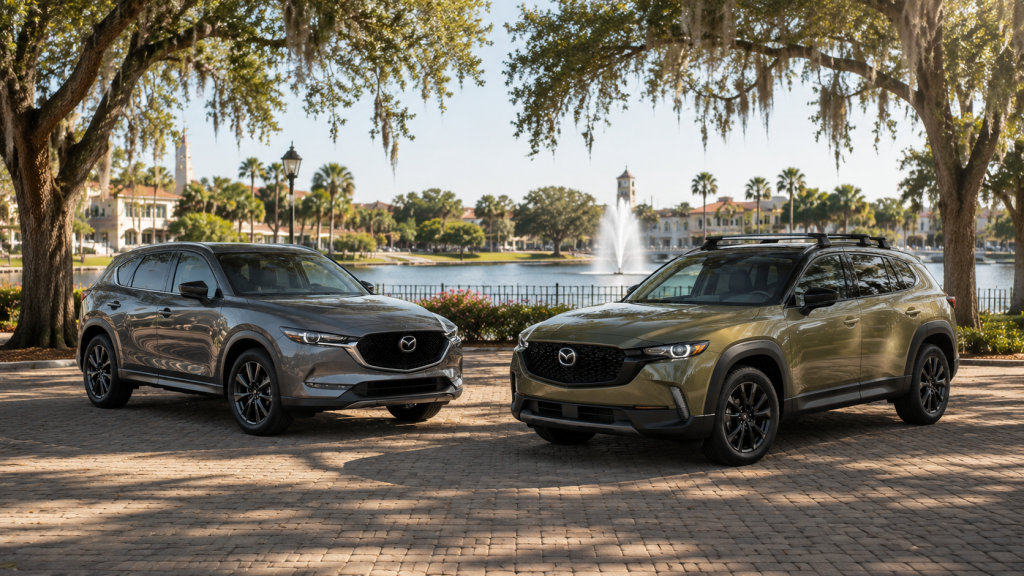
CX 5 vs CX 50 Hybrid comparisons usually begin with fuel economy, though cargo space, powertrain feel, cabin layout, and daily driving rhythm shape the larger decision. These two Mazda SUVs overlap heavily in size and purpose, which creates confusion for shoppers narrowing their options. Both support all wheel drive confidence, passenger comfort, and Mazda’s connected steering philosophy, yet they approach those goals through different powertrain and packaging strategies.

The Mazda CX 5 continues using a traditional gas powered setup focused on smooth throttle response, balanced ride comfort, and familiar acceleration delivery. The Mazda CX 50 Hybrid introduces electric motor assistance and hybrid energy management to reduce fuel use during commuting and lower speed driving. While the dimensions appear close on paper, the ownership feel changes once these SUVs are driven back to back.

Hybrid Efficiency Versus Traditional Gas Power

Is the CX 50 Hybrid more efficient than the CX 5? The CX 50 Hybrid uses a hybrid powertrain that combines a gasoline engine with electric motor support. During slower driving, stoplights, and lower speed traffic movement, the electric motor assists propulsion and reduces how heavily the gasoline engine needs to work.

That changes fuel use patterns most noticeably during:

  • stop and go commuting
  • suburban traffic movement
  • lower speed errands
  • repeated acceleration cycles
  • city driving with frequent slowing

The hybrid setup continuously shifts energy between regenerative braking, battery support, and gasoline operation. When the driver lifts off the accelerator or brakes, energy is redirected back into the battery system instead of being lost entirely through heat during braking.

The Mazda CX 5 uses a more traditional powertrain structure with direct gasoline engine response. Acceleration feels linear and immediate because throttle response comes directly from engine output instead of transitioning between electric assist and gasoline support.

Some drivers prefer this because:

  • acceleration feels more familiar
  • engine response remains predictable
  • highway merging feels more direct
  • throttle modulation stays consistent
  • engine sound and speed remain connected

The CX 50 Hybrid delivers stronger efficiency during traffic heavy commuting while the CX 5 maintains a more traditional Mazda driving character. Neither approach is automatically better. The difference depends heavily on where and how the SUV spends most of its time.

Cargo Space and Cabin Layout Feel Different in Use

Which Mazda SUV has more usable cargo space? Cargo measurements alone rarely explain how an SUV feels during loading and passenger use. Rear hatch opening width, floor height, seat folding shape, and passenger layout influence how usable the space feels once luggage, groceries, sports gear, or travel equipment enter the picture.

The Mazda CX 5 focuses heavily on balanced passenger and cargo packaging. Rear passengers sit in a cabin that feels slightly more enclosed and comfort focused while the cargo area maintains strong loading flexibility behind the second row.

The CX 50 Hybrid introduces a wider visual stance and more rugged cargo presentation. The rear cargo opening feels broader visually while the overall body structure emphasizes outdoor travel and active use styling.

Cargo usability differences become noticeable during:

  • grocery loading
  • luggage stacking
  • pet crate placement
  • sports equipment storage
  • stroller loading
  • rear seat folding transitions

The Mazda CX 5 cargo layout feels more traditionally organized while the CX 50 Hybrid leans toward an open and adventure focused presentation. Drivers who prioritize interior comfort and cleaner cabin integration may lean toward the CX 5. Drivers carrying larger outdoor equipment or road trip gear may appreciate the broader visual layout of the hybrid model.

Rear passenger movement matters as well. Family shoppers should evaluate:

  • rear door opening size
  • rear seat access
  • cargo floor height
  • child seat loading movement
  • rear visibility while parking

These details shape daily ownership much more than specification charts alone.

Steering Feel and All Wheel Drive Character

Which Mazda SUV feels easier to drive every day? Mazda tuning philosophy centers around steering precision, body control, and natural driver connection. Both SUVs reflect that philosophy, though their personalities separate once the road begins changing direction or traffic density increases.

The Mazda CX 5 maintains a slightly lower feeling body posture and a smoother transition between steering inputs. The gas powertrain contributes to a more connected acceleration relationship because throttle response remains mechanically direct.

The CX 50 Hybrid changes the driving rhythm slightly through:

  • electric motor torque delivery
  • hybrid braking transitions
  • different weight distribution
  • regenerative braking interaction
  • altered acceleration pacing

Electric motor assistance creates quicker low speed torque delivery from stops. During slower traffic movement, the SUV responds smoothly and quietly because the electric motor supplements early acceleration before the gasoline engine increases workload.

Mazda all wheel drive tuning also shapes how these SUVs feel through corners and changing road surfaces. Both vehicles monitor wheel slip, steering angle, throttle position, and traction demands continuously. Torque distribution shifts proactively instead of waiting for substantial wheel slip to develop first.

Drivers comparing the two should evaluate:

  • steering weight
  • braking smoothness
  • parking visibility
  • highway stability
  • acceleration feel from stoplights
  • body movement during lane changes

The CX 5 preserves a more traditional connected driving feel while the CX 50 Hybrid introduces smoother low speed efficiency oriented movement.

Commuting, Road Trips, and Family Fit

Which SUV fits commuting and road trips better? The answer depends heavily on mileage patterns, passenger routines, and cargo expectations.

The Mazda CX 50 Hybrid fits strongly into:

  • heavy commuting schedules
  • urban traffic movement
  • fuel conscious driving
  • longer stop and go routes
  • lower speed suburban travel

Drivers spending large amounts of time in traffic may notice fuel savings more substantially because hybrid systems gain the most advantage during repeated slowing and acceleration.

The Mazda CX 5 remains strong for:

  • balanced family driving
  • highway travel
  • traditional gas SUV familiarity
  • smoother throttle response
  • comfort focused commuting

Highway focused drivers may notice the efficiency gap narrows somewhat once speeds remain more constant for longer periods. Hybrid systems create their largest efficiency advantages during lower speed traffic patterns where regenerative braking and electric assist remain active more frequently.

Family shoppers should also evaluate:

  • rear passenger comfort
  • cargo organization
  • highway seat comfort
  • visibility during parking
  • infotainment layout
  • Apple CarPlay integration visibility

Mazda structures interior technology carefully across both SUVs so navigation, climate controls, and media interaction remain visually clean and easier to manage during driving.

Which Mazda SUV Fits Your Priorities Better

What should shoppers evaluate before choosing between the two? The strongest comparison point is not simply hybrid versus gas power. The larger question involves how the SUV will spend most of its life.

Drivers prioritizing commuting efficiency, stop and go traffic reduction, and lower speed fuel savings may lean naturally toward the Mazda CX 50 Hybrid. The electrified powertrain changes how the SUV responds during traffic while supporting stronger fuel efficiency during urban movement.

Drivers prioritizing smoother traditional acceleration feel, comfort focused driving rhythm, and familiar gasoline response may prefer the Mazda CX 5. The vehicle maintains Mazda’s connected steering feel while balancing passenger comfort and cargo flexibility in a cleaner and more familiar package.

Both SUVs continue reflecting Mazda’s human centered engineering philosophy through:

  • balanced steering calibration
  • intuitive cabin layouts
  • driver centered visibility
  • controlled body movement
  • measured technology integration

The CX 50 Hybrid expands Mazda’s electrified SUV direction while the CX 5 continues delivering one of the most recognizable driving personalities in the compact SUV segment. The better fit comes from understanding how your commute, cargo needs, passenger routines, and driving priorities intersect with the strengths each SUV delivers daily.

Posted in:

Related Posts

2026 Mazda MX-5 Miata vs Mazda3 Hatchback: Driving Engagement Compared

The 2026 Mazda MX-5 Miata vs Mazda3 Hatchback comparison is not a contest between a sports car and a sensible compact. Both vehicles carry Mazda's core engineering philosophy. Both reward a driver who pays attention. However, they deliver that reward through entirely different mechanical approaches. Understanding what each chassis actually does changes how clearly a driver can evaluate which one fits the way they drive. How the Two Chassis Architectures Create Different Engagement Drivetrain layout shapes how a car communicates with its driver more than almost any other single factor. The MX-5 Miata uses a rear-wheel drive layout. The Mazda3 Hatchback uses front-wheel drive, with i-Activ AWD available on upper trims. In a front-wheel drive vehicle, the front tires handle both steering and power delivery at the same time. Under hard acceleration, weight transfers rearward and reduces load on the front axle. That shift creates a mild tug through the steering wheel as the front tires work against the competing demands of turning and driving. The Mazda3's engineers address this through precise chassis tuning and the available AWD system, which distributes torque across all four corners and reduces that front-axle conflict considerably. more The MX-5 separates those demands entirely. The front tires steer. The rear tires drive. That division allows each axle to do one job cleanly. Moreover, the rear-drive layout allows the driver to use throttle input to influence the car's cornering attitude in ways a front-drive platform cannot replicate. A driver who trails the throttle into a corner in the MX-5 shifts weight forward, loads the front tires, and sharpens turn-in. That communication runs through the steering wheel, the seat, and the pedals simultaneously. It is the mechanical definition of Jinba Ittai at the chassis level. What the MX-5 Miata's Lightweight Platform Delivers The 2026 MX-5 Miata soft top weighs approximately 2,366 lbs. That number drives the engagement model more than the 181 hp engine does. Low mass changes the felt intensity of every input. A throttle press, a steering correction, a braking point reached slightly late each produces a more immediate and more communicative response than the same input would in a heavier vehicle. The near 50/50 front-to-rear weight distribution reinforces this. Weight sits balanced across both axles at rest. Through a corner, neither end carries disproportionate load. As a result, the car rotates predictably and the driver can place it with confidence. The following specifications define the MX-5's engagement architecture in concrete terms:caranddriver+1 At approximately 2,366 lbs, the soft top MX-5 produces roughly 76 hp per 1,000 lbs of vehicle weight, which places it among the highest power-to-weight ratios in its price class and explains why 181 hp feels far more alive in this chassis than the same output would in a heavier car. The near 50/50 weight distribution means the front and rear axles carry roughly equal load at rest, which allows the suspension to work symmetrically through direction changes and gives the driver consistent feedback from both ends of the car at the same time. The short 90.9-inch wheelbase concentrates the vehicle's mass close to the center of the car, reducing rotational inertia and allowing the chassis to change direction with a quickness that longer-wheelbase vehicles cannot produce regardless of their power output. The RF adds a retractable fastback roof and approximately 100 lbs over the soft top. That modest weight increase preserves nearly all of the soft top's engagement character while adding weather insulation and a quieter cabin at highway speeds. What Does the Mazda3 Hatchback Bring to the Engagement Conversation? The Mazda3 Hatchback is not a car that asks its driver to compromise between engagement and usability. It is a car that delivers both on the same trip. The standard 2.5-liter naturally aspirated engine produces 191 hp. That output moves the Mazda3 with genuine confidence on a two-lane road or a highway on-ramp. The turbocharged variant changes the conversation further. The 2.5-liter turbo produces 250 hp and 320 lb-ft of torque. Paired with i-Activ AWD, it reaches 60 mph in under six seconds. That performance envelope puts the Mazda3 Turbo in legitimate sports compact territory. However, it delivers that performance without the MX-5's physical involvement. The AWD system manages traction distribution electronically. The chassis isolates the driver from the road texture that the MX-5 transmits directly through its structure. How the Mazda3 Hatchback Earns Its Engagement Credentials The Mazda3's engagement comes from a different source than the Miata's. Its steering is precise and well-weighted. The suspension tuning produces a composed, planted feel through corners without the stiffness that often comes with sporty compact setups. G-Vectoring Control runs continuously, making micro-torque adjustments at turn-in that keep weight loaded on the front tires through corners. Beyond that, the 2026 model year refines the cabin materials and driving position further, tightening the connection between driver and car in the way Mazda consistently prioritizes across the lineup. How Jinba Ittai Applies Differently to Each Vehicle Jinba Ittai translates roughly as oneness between horse and rider. Mazda applies it as an engineering target, not a marketing phrase. The goal is a vehicle that responds so naturally to driver inputs that the boundary between person and machine becomes difficult to locate. Both the MX-5 and the Mazda3 pursue that target. They reach it through different paths. The MX-5 pursues Jinba Ittai through physical directness. Low mass reduces the inertia between input and response. Rear-wheel drive separates steering and power delivery so each communicates cleanly. The short wheelbase and balanced weight distribution make the car rotate around the driver rather than requiring the driver to manage a larger, heavier chassis. Every mechanical choice prioritizes the intensity of the connection over the breadth of the car's capabilities. The Mazda3 pursues the same target through refinement and precision. Its steering communicates road surface and cornering load without amplifying harshness. The chassis absorbs road irregularities and returns a stable, predictable platform that a driver can push with confidence. G-Vectoring Control adds a layer of weight-transfer management that makes the car feel more balanced than its front-drive layout would suggest without it. The result is a car where the driver feels competent and in control rather than physically immersed in the road. Neither expression is a lesser version of the other. They reflect two genuinely different answers to the same engineering question. Which Vehicle Fits Which Driver The right choice between these two comes down to how a driver weighs engagement intensity against daily versatility. Both cars reward attention. They reward it differently and they ask different things in return. A driver who prioritizes the physical experience of driving above most other factors, who takes two-lane roads deliberately, and who can manage a two-seat cabin and minimal cargo space in daily life will find the MX-5 irreplaceable. No car at its price point delivers the same level of chassis communication, weight distribution purity, and driver involvement. That experience has a real cost in practicality. A driver who wants genuine driving satisfaction on every commute, the flexibility to carry passengers and cargo, and the option of turbocharged AWD performance in a refined and comfortable daily package will find the Mazda3 Hatchback a more complete answer. It does not provide the MX-5's physical intensity. However, it provides daily engagement without requiring the driver to plan around the limitations of a two-seat roadster. The following questions help clarify which vehicle serves a given driver better: If the driver regularly carries more than one passenger, needs cargo space beyond a weekend bag, or lives in a region with significant winter weather and no secondary vehicle, the Mazda3 Hatchback with i-Activ AWD serves those needs without sacrificing driving engagement on roads that reward a well-tuned compact. If the driver primarily commutes solo, values the physical sensation of driving above passenger comfort or cargo room, and treats backroads and weekend routes as a priority rather than an occasional bonus, the MX-5 Miata delivers an experience that no other vehicle in the Mazda lineup can replicate at any price. Both the MX-5 and the Mazda3 Hatchback represent Mazda's commitment to building cars that move the driver, not just the passengers. The difference is the form that movement takes. One puts the road in your hands. The other puts it beneath your feet. Knowing which sensation you want is the most honest way to choose between them.

Mazda Drive Modes Explained: Efficiency, Comfort, and Control

Mazda drive modes do more than adjust how a car feels. Each mode recalibrates how the vehicle distributes power, shifts gears, and responds to throttle input at a system level. Drivers who understand what changes mechanically with each selection make better decisions about when to switch. Furthermore, they get more from the engineering Mazda built into every model in the lineup. What Mi-Drive Is and How It Works as a System Mi-Drive stands for Mazda intelligent Drive Select. It is the platform that governs drive mode selection across Mazda's current lineup, including the CX-5, CX-50, CX-90, and CX-30. Most drivers think of drive modes as single-variable adjustments. Mi-Drive does not work that way. When a driver selects a mode, Mi-Drive adjusts three vehicle systems at the same time. First, it reprograms the throttle mapping, which changes how the engine responds to pedal input. Second, it adjusts the transmission shift logic, which changes the RPM range the vehicle uses before upshifting. Third, on models equipped with i-Activ AWD, it redistributes torque bias between the front and rear axles to match the selected mode's traction priorities. more Each of those three changes affects the others. A sharpened throttle map in Sport mode produces more frequent and more aggressive throttle inputs. Those inputs interact directly with the recalibrated shift logic to hold gears longer. The result is a coordinated shift in how the entire drivetrain behaves, not a single dial turned up. Understanding Mi-Drive as a multi-system calibration tool rather than a preference setting changes how usefully a driver can apply each mode. How Normal Mode Works and When It Serves Drivers Best Normal mode is not a compromise or a factory default that exists because no one selected anything else. Mazda engineers it as the primary calibration for everyday driving. It represents Mazda's most carefully tuned balance between throttle sensitivity, transmission efficiency, and fuel economy across a wide range of road conditions. In Normal mode, the transmission shift mapping prioritizes early upshifts. The Mazda3 and CX-5 with SKYACTIV-G engines shift into higher gears at lower RPMs, keeping the engine in its most fuel-efficient operating range during highway cruising and city traffic. The throttle map is linear, meaning pedal travel translates to engine response proportionally without the amplification Sport mode introduces. Why Normal Mode Rewards Consistent Driving For drivers covering mixed commuting and highway miles, Normal mode consistently returns the best fuel economy figures across the lineup. The early shift behavior reduces engine load during acceleration. Beyond that, the linear throttle map prevents the small, unintentional over-throttle inputs that Sport mode amplifies into more aggressive acceleration. Drivers who cover mostly highway miles or mixed city routes will find Normal mode protects fuel economy without reducing responsiveness in everyday situations. What Does Sport Mode Change and What Does It Not? Sport mode does not add horsepower. The engine produces the same peak output in every mode. What Sport mode changes is how and when that output becomes available to the driver. In Sport mode, Mi-Drive reprograms the throttle map to amplify pedal input. A light press of the accelerator produces a stronger engine response than the same press would generate in Normal mode. At the same time, the transmission holds gears to higher RPMs before upshifting. A CX-5 or Mazda3 in Sport mode will stay in a lower gear through a curve or during an overtake where Normal mode would have already shifted up. That behavior gives the driver access to more torque in the moment without requiring a downshift request. The fuel economy trade-off is direct. Holding higher RPMs and responding more aggressively to throttle inputs increases fuel consumption. The trade-off is smallest at highway speeds where throttle inputs are steady and modest. It is largest in stop-and-go traffic where Sport mode amplifies every small throttle correction into a larger fuel draw. The following changes occur at the system level when Sport mode is active: The throttle map shifts from linear to amplified, meaning a given pedal position produces a larger throttle opening than the same position would in Normal mode, increasing torque delivery at partial throttle. The transmission hold RPM threshold rises, keeping the SKYACTIV-G or SKYACTIV-X engine in its peak torque band longer before the next upshift, which improves in-gear acceleration without requiring a manual downshift. On i-Activ AWD models, the rear axle receives a slightly higher torque bias, which increases drive feel and stability during cornering by loading the rear tires more consistently through acceleration. Sport mode rewards purposeful use. Highway on-ramps, mountain roads, and overtaking situations are where its calibration returns value. City commuting in Sport mode increases fuel consumption without producing a meaningful improvement in how the car moves through traffic. How G-Vectoring Control Works Across All Drive Modes G-Vectoring Control, or GVC, operates independently of Mi-Drive mode selection. It runs continuously in the background across Normal, Sport, and every other available mode. However, its effect on driving feel becomes most noticeable in Sport mode because of how the two systems interact. GVC works by making micro-reductions to engine torque at the moment a driver turns the steering wheel. That brief torque reduction shifts a small amount of weight onto the front tires at turn-in. With more load on the front axle, the tires generate more cornering grip at the precise moment the driver needs steering response. As the driver unwinds the wheel at corner exit, GVC restores torque smoothly, which transfers weight back toward the rear and stabilizes the car under acceleration. In Normal mode, GVC operates on relatively small and gradual throttle inputs. Its torque adjustments are modest and the transitions stay smooth. In Sport mode, the amplified throttle map produces sharper and more frequent torque changes. GVC responds to each of those changes, making its weight transfer adjustments more active throughout a corner. The result is that Sport mode and GVC work together to sharpen steering response and body control simultaneously. Drivers who notice that the CX-5 or Mazda3 feels more planted and responsive in Sport mode during corners are experiencing GVC and Mi-Drive operating in coordination. Off-Road and Towing Modes: What Changes at the System Level Off-Road and Towing modes address specific driving scenarios that Normal and Sport modes are not calibrated for. Both are available on select Mi-Drive-equipped models including the CX-50, CX-90, and CX-70. Off-Road mode raises the traction control intervention threshold. In Normal mode, the traction control system responds quickly to wheel slip and reduces torque to restore grip. That fast intervention works well on paved surfaces. On loose gravel, sand, or snow, a small amount of wheel slip is productive because it allows the tires to dig into the surface. Off-Road mode tells the traction control system to allow more slip before intervening. At the same time, i-Activ AWD shifts torque rearward and distributes it more evenly across all four corners. The throttle map becomes more progressive, reducing the chance of sudden torque spikes that break traction on loose surfaces. Towing mode addresses a different set of demands. A loaded trailer changes the vehicle's weight distribution, braking distance, and transmission heat load. Towing mode recalibrates the transmission shift logic to hold lower gears longer, which reduces the frequency of hunting between gears on grades. It also adjusts AWD torque distribution to account for the added rear weight from the trailer hitch load. The following changes occur when Off-Road or Towing mode is active: Off-Road mode raises the traction control slip threshold and shifts AWD torque toward a more even four-corner distribution, allowing productive wheel slip on loose surfaces while maintaining directional stability through the AWD system. Towing mode recalibrates transmission shift points to reduce gear hunting on inclines and adjusts AWD torque bias rearward to compensate for trailer tongue weight pressing down on the hitch. Both modes return the vehicle to its standard calibrations the moment Normal or Sport is selected again. Neither mode modifies any permanent vehicle setting. Drivers with CX-50 or CX-90 models covering gravel roads, boat launches, or mountain grades will find that selecting the correct specialized mode produces measurably more stable and controlled vehicle behavior than leaving the vehicle in Normal mode for those specific scenarios.

Understanding Mazda i Activsense Safety Technology

Mazda i Activsense features are built to support awareness during the small driving moments that happen every day, from highway merging to crowded parking lots. The technology inside these driver assistance features is not meant to overpower the person behind the wheel or create constant interruptions. Mazda approaches safety through support and connection, shaping technology around natural movement and driver awareness instead of aggressive intervention. That philosophy reflects Mazda’s human centered design approach, where technology exists to work with the driver in a calm and intuitive way. Modern Mazda vehicles such as the Mazda CX 5 and Mazda CX 90 use cameras, radar sensors, steering inputs, and braking communication to monitor traffic movement around the vehicle continuously. While these features sound highly technical on paper, most drivers notice them through subtle moments. A warning light appears beside the mirror during a lane change. The steering wheel gently responds near a lane edge. The vehicle adjusts following distance during traffic flow. These interactions are intentionally smooth so the technology feels supportive instead of distracting. How Mazda i Activsense Uses Cameras and Radar Together What does Mazda i Activsense do? Mazda i Activsense is a collection of driver awareness features that monitor surrounding traffic, lane positioning, vehicle spacing, and potential collision risks through coordinated sensor communication. Different sensors perform different jobs. Cameras mounted near the windshield monitor lane markings, road positioning, and object recognition. Radar sensors monitor traffic speed and surrounding vehicle movement. The vehicle’s onboard processing system combines these inputs continuously while driving. A Mazda CX 90 traveling through highway traffic may use: more Forward radar to measure following distance Cameras to monitor lane positioning Steering sensors to evaluate driver inputs Brake system communication to prepare intervention timing Speed monitoring to calculate traffic pacing These features work together instead of operating independently. When adaptive cruise control adjusts following distance, the vehicle is simultaneously evaluating lane positioning, traffic speed changes, and steering inputs. Mazda calibrates these interactions carefully so the vehicle responds naturally without abrupt reactions. That smoother calibration changes how the technology feels during commuting. Some driver assistance systems from other manufacturers interrupt the drive aggressively through loud warnings or sudden corrections. Mazda focuses on gradual awareness support that blends into normal driving rhythm more naturally. Blind Spot Monitoring and Rear Traffic Awareness During City Driving How does blind spot monitoring work? Blind spot monitoring uses radar sensors positioned near the rear corners of the vehicle to detect traffic moving beside or approaching the Mazda from neighboring lanes. When another vehicle enters the monitored zone, an indicator appears near the side mirror. If the driver activates a turn signal while traffic remains inside the monitored area, the system increases the alert through visual and audible warnings. The Mazda CX 5 rear visibility layout already provides strong outward visibility through thoughtful design proportions and window placement. Blind spot monitoring adds another layer of awareness by detecting movement outside direct sightlines during lane changes and merging situations. Rear cross traffic alert expands this awareness further while backing out of parking spaces. Parking lots create difficult visibility angles because larger vehicles, shopping carts, landscaping barriers, and traffic movement block clear sightlines behind the vehicle. Rear traffic monitoring helps detect: Crossing vehicle movement Approaching traffic from side aisles Movement hidden behind larger vehicles Traffic approaching outside mirror visibility Motion during low speed reversing Radar sensors scan side to side movement behind the vehicle while reversing. If approaching traffic enters the monitored zone, the system alerts the driver before the crossing vehicle becomes fully visible through the rear camera or mirrors. These alerts matter most during crowded parking situations where traffic movement changes rapidly and visibility disappears quickly between parked vehicles. Adaptive Cruise Control Changes Highway Driving Rhythm How does adaptive cruise control react to traffic? Adaptive cruise control monitors the distance between the Mazda and vehicles ahead while automatically adjusting speed to maintain selected spacing. Traditional cruise control maintains fixed speed regardless of surrounding traffic. Adaptive cruise control adds traffic awareness by calculating distance and closing speed continuously through forward radar monitoring. A Mazda CX 90 driving through highway congestion evaluates: Vehicle speed ahead Closing distance rate Traffic slowdown patterns Lane movement changes Acceleration pacing When traffic slows, the system reduces throttle input gradually and may apply braking pressure smoothly to preserve spacing. Once traffic begins moving again, acceleration returns progressively toward the selected cruising speed. Mazda calibrates acceleration and braking transitions carefully because abrupt speed changes create discomfort and tension during longer highway drives. The goal is not automation for its own sake. The goal is maintaining a smoother driving rhythm that reduces constant throttle and brake adjustments during traffic flow. This becomes noticeable during: Stop and go traffic Long highway commutes Multi lane traffic pacing Gradual traffic slowdowns Highway construction merging The technology still expects driver engagement. Steering input, awareness, and surrounding traffic evaluation remain centered around the driver. Mazda positions these features as assistance tools supporting awareness instead of replacing driver involvement entirely. Lane Departure Systems Support Steering Awareness Does Mazda steering assist take over driving? Lane departure systems support steering awareness through gentle correction assistance when the vehicle begins drifting unintentionally outside lane markings. Forward cameras monitor lane lines continuously while evaluating steering inputs and vehicle positioning. If the system detects lane departure without turn signal activation, alerts begin gradually. Mazda lane support may include: Steering wheel vibration Visual dashboard notifications Audible lane alerts Gentle steering correction pressure Lane centering support during highway travel The steering correction itself remains intentionally restrained. Mazda avoids heavy handed intervention because overly aggressive correction can feel unnatural or startling during normal driving. That calmer approach reflects Mazda’s broader driving philosophy. Mazda vehicles are engineered around driver connection and natural steering feel, so assistance technology is tuned to preserve that relationship instead of overpowering it. Lane departure support becomes most useful during moments of reduced attention, highway fatigue, nighttime driving, or long distance commuting where subtle drifting can happen gradually without immediate awareness. Why Mazda Safety Technology Feels Supportive Instead of Intrusive Why do Mazda safety features feel calmer to use? Mazda calibrates driver assistance technology around human movement patterns and natural driving rhythm instead of constant intervention. The company’s Jinba Ittai philosophy centers around the connection between driver and vehicle. That philosophy shapes how steering support activates, how alerts are timed, how braking intervention begins, and how the vehicle communicates with the driver overall. Mazda safety systems explained through technical specifications alone miss the larger point. The technology is intended to feel quiet, balanced, and intuitive during normal driving moments. That philosophy shapes: Alert timing Steering correction intensity Braking smoothness Traffic pacing response Visual warning placement Driver awareness interaction Mazda and Apple CarPlay integration reflects a similar approach. Technology inside the cabin is structured around clarity and intuitive interaction instead of overwhelming menus or excessive visual distraction. The result is a driving atmosphere where safety technology stays present without becoming the center of attention. Drivers still feel connected to the road, aware of surrounding movement, and engaged with the vehicle naturally. Mazda safety technology supports awareness through subtle communication, thoughtful calibration, and calm interaction. Whether driving a Mazda CX 5 through crowded city traffic or traveling long highway stretches inside a Mazda CX 90, these features are designed to support the moments where awareness matters most while preserving the feeling that driving still belongs to the person behind the wheel.