Blog / Orange Park Florida Mazda Dealer

2026 Mazda MX-5 Miata vs Mazda3 Hatchback: Driving Engagement Compared

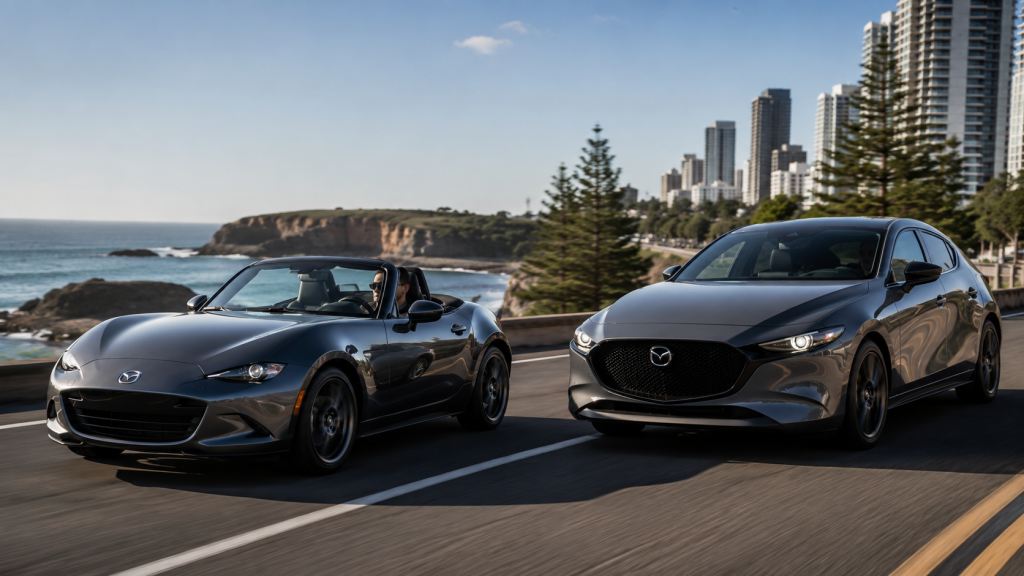
The 2026 Mazda MX-5 Miata vs Mazda3 Hatchback comparison is not a contest between a sports car and a sensible compact. Both vehicles carry Mazda's core engineering philosophy. Both reward a driver who pays attention. However, they deliver that reward through entirely different mechanical approaches. Understanding what each chassis actually does changes how clearly a driver can evaluate which one fits the way they drive.

How the Two Chassis Architectures Create Different Engagement

Drivetrain layout shapes how a car communicates with its driver more than almost any other single factor. The MX-5 Miata uses a rear-wheel drive layout. The Mazda3 Hatchback uses front-wheel drive, with i-Activ AWD available on upper trims.

In a front-wheel drive vehicle, the front tires handle both steering and power delivery at the same time. Under hard acceleration, weight transfers rearward and reduces load on the front axle. That shift creates a mild tug through the steering wheel as the front tires work against the competing demands of turning and driving. The Mazda3's engineers address this through precise chassis tuning and the available AWD system, which distributes torque across all four corners and reduces that front-axle conflict considerably.

The MX-5 separates those demands entirely. The front tires steer. The rear tires drive. That division allows each axle to do one job cleanly. Moreover, the rear-drive layout allows the driver to use throttle input to influence the car's cornering attitude in ways a front-drive platform cannot replicate. A driver who trails the throttle into a corner in the MX-5 shifts weight forward, loads the front tires, and sharpens turn-in. That communication runs through the steering wheel, the seat, and the pedals simultaneously. It is the mechanical definition of Jinba Ittai at the chassis level.

What the MX-5 Miata's Lightweight Platform Delivers

The 2026 MX-5 Miata soft top weighs approximately 2,366 lbs. That number drives the engagement model more than the 181 hp engine does. Low mass changes the felt intensity of every input. A throttle press, a steering correction, a braking point reached slightly late each produces a more immediate and more communicative response than the same input would in a heavier vehicle.

The near 50/50 front-to-rear weight distribution reinforces this. Weight sits balanced across both axles at rest. Through a corner, neither end carries disproportionate load. As a result, the car rotates predictably and the driver can place it with confidence.

The following specifications define the MX-5's engagement architecture in concrete terms:caranddriver+1

  • At approximately 2,366 lbs, the soft top MX-5 produces roughly 76 hp per 1,000 lbs of vehicle weight, which places it among the highest power-to-weight ratios in its price class and explains why 181 hp feels far more alive in this chassis than the same output would in a heavier car.
  • The near 50/50 weight distribution means the front and rear axles carry roughly equal load at rest, which allows the suspension to work symmetrically through direction changes and gives the driver consistent feedback from both ends of the car at the same time.
  • The short 90.9-inch wheelbase concentrates the vehicle's mass close to the center of the car, reducing rotational inertia and allowing the chassis to change direction with a quickness that longer-wheelbase vehicles cannot produce regardless of their power output.

The RF adds a retractable fastback roof and approximately 100 lbs over the soft top. That modest weight increase preserves nearly all of the soft top's engagement character while adding weather insulation and a quieter cabin at highway speeds.

What Does the Mazda3 Hatchback Bring to the Engagement Conversation?

The Mazda3 Hatchback is not a car that asks its driver to compromise between engagement and usability. It is a car that delivers both on the same trip. The standard 2.5-liter naturally aspirated engine produces 191 hp. That output moves the Mazda3 with genuine confidence on a two-lane road or a highway on-ramp.

The turbocharged variant changes the conversation further. The 2.5-liter turbo produces 250 hp and 320 lb-ft of torque. Paired with i-Activ AWD, it reaches 60 mph in under six seconds. That performance envelope puts the Mazda3 Turbo in legitimate sports compact territory. However, it delivers that performance without the MX-5's physical involvement. The AWD system manages traction distribution electronically. The chassis isolates the driver from the road texture that the MX-5 transmits directly through its structure.

How the Mazda3 Hatchback Earns Its Engagement Credentials

The Mazda3's engagement comes from a different source than the Miata's. Its steering is precise and well-weighted. The suspension tuning produces a composed, planted feel through corners without the stiffness that often comes with sporty compact setups. G-Vectoring Control runs continuously, making micro-torque adjustments at turn-in that keep weight loaded on the front tires through corners. Beyond that, the 2026 model year refines the cabin materials and driving position further, tightening the connection between driver and car in the way Mazda consistently prioritizes across the lineup.

How Jinba Ittai Applies Differently to Each Vehicle

Jinba Ittai translates roughly as oneness between horse and rider. Mazda applies it as an engineering target, not a marketing phrase. The goal is a vehicle that responds so naturally to driver inputs that the boundary between person and machine becomes difficult to locate. Both the MX-5 and the Mazda3 pursue that target. They reach it through different paths.

The MX-5 pursues Jinba Ittai through physical directness. Low mass reduces the inertia between input and response. Rear-wheel drive separates steering and power delivery so each communicates cleanly. The short wheelbase and balanced weight distribution make the car rotate around the driver rather than requiring the driver to manage a larger, heavier chassis. Every mechanical choice prioritizes the intensity of the connection over the breadth of the car's capabilities.

The Mazda3 pursues the same target through refinement and precision. Its steering communicates road surface and cornering load without amplifying harshness. The chassis absorbs road irregularities and returns a stable, predictable platform that a driver can push with confidence. G-Vectoring Control adds a layer of weight-transfer management that makes the car feel more balanced than its front-drive layout would suggest without it. The result is a car where the driver feels competent and in control rather than physically immersed in the road.

Neither expression is a lesser version of the other. They reflect two genuinely different answers to the same engineering question.

Which Vehicle Fits Which Driver

The right choice between these two comes down to how a driver weighs engagement intensity against daily versatility. Both cars reward attention. They reward it differently and they ask different things in return.

A driver who prioritizes the physical experience of driving above most other factors, who takes two-lane roads deliberately, and who can manage a two-seat cabin and minimal cargo space in daily life will find the MX-5 irreplaceable. No car at its price point delivers the same level of chassis communication, weight distribution purity, and driver involvement. That experience has a real cost in practicality.

A driver who wants genuine driving satisfaction on every commute, the flexibility to carry passengers and cargo, and the option of turbocharged AWD performance in a refined and comfortable daily package will find the Mazda3 Hatchback a more complete answer. It does not provide the MX-5's physical intensity. However, it provides daily engagement without requiring the driver to plan around the limitations of a two-seat roadster.

The following questions help clarify which vehicle serves a given driver better:

  • If the driver regularly carries more than one passenger, needs cargo space beyond a weekend bag, or lives in a region with significant winter weather and no secondary vehicle, the Mazda3 Hatchback with i-Activ AWD serves those needs without sacrificing driving engagement on roads that reward a well-tuned compact.
  • If the driver primarily commutes solo, values the physical sensation of driving above passenger comfort or cargo room, and treats backroads and weekend routes as a priority rather than an occasional bonus, the MX-5 Miata delivers an experience that no other vehicle in the Mazda lineup can replicate at any price.

Both the MX-5 and the Mazda3 Hatchback represent Mazda's commitment to building cars that move the driver, not just the passengers. The difference is the form that movement takes. One puts the road in your hands. The other puts it beneath your feet. Knowing which sensation you want is the most honest way to choose between them.


Posted in:

Related Posts

Mazda CX-50 Hybrid vs Honda CR-V Hybrid Daily Use Guide

Mazda CX-50 Hybrid vs Honda CR-V Hybrid Daily Use Guide

Mazda CX-50 Hybrid vs Honda CR-V Hybrid Daily Use Guide Mazda CX-50 Hybrid vs Honda CR-V Hybrid comparisons involve more than fuel economy. Both compact SUVs pair gasoline engines with electric motors. However, their power, AWD setup, cargo space, and cabin layouts differ. The right comparison starts with how you plan to drive and carry passengers. Additionally, trim choice matters on the Honda side because AWD and fuel ratings change across the lineup. Mazda CX-50 Hybrid and Honda CR-V Hybrid Use Different Hybrid Layouts The CX-50 Hybrid pairs a 2.5 liter four cylinder engine with three electric motors. Together, they produce 219 horsepower. An electronically controlled continuously variable transmission sends power through standard e-AWD. The CR-V Hybrid uses a two motor hybrid layout with 204 total horsepower. Honda offers front wheel drive on Sport Hybrid. Real Time AWD is available or standard on other hybrid trims. The main mechanical differences are easier to review when they are separated by category: The Mazda CX-50 Hybrid produces 219 horsepower from its 2.5 liter engine and three electric motor setup. The Honda CR-V Hybrid produces 204 total horsepower from its two motor hybrid system. The Mazda includes e-AWD on every trim, while Honda AWD availability changes by trim. The CX-50 Hybrid includes Power and Trail drive modes across the lineup. Those specifications create different paths before you even choose cabin features. Therefore, shoppers who want standard AWD have a simpler Mazda trim decision. Honda customers need to confirm drivetrain configuration on the exact CR-V Hybrid trim. You can review the 2026 Mazda CX-50 lineup at Mazda City before comparing available hybrid trims. How Does AWD Differ Between the CX-50 Hybrid and CR-V Hybrid? Every CX-50 Hybrid includes electronic AWD. The layout can direct power between the front and rear wheels as the vehicle operates. Mazda also includes Power and Trail drive modes across all three hybrid trims. Honda structures AWD differently. Sport Hybrid can use front wheel drive or available Real Time AWD. Sport-L Hybrid also offers AWD. TrailSport Hybrid and Sport Touring Hybrid come with AWD. Therefore, the Honda trim choice changes both drivetrain and EPA fuel ratings. The Mazda keeps the same basic AWD configuration across Preferred, Premium, and Premium Plus. During a test drive, compare low speed response and acceleration from a stop. Additionally, try steady cruising and normal turns. These checks give you a better sense of each hybrid layout than horsepower alone. Passenger Space and Cargo Space Need Separate Evaluation Cargo figures tell part of the story, but they do not show how your family will load the cabin. Mazda lists 29.2 cubic feet behind the second row. Folding the rear seats opens up 56.3 cubic feet. The CR-V Hybrid provides more published cargo room. Current specifications list 36.3 cubic feet behind the second row and greater maximum volume with the rear seats folded. When you compare both SUVs, use the cabin the way you normally would: Set the front seats first, then sit in the second row to check knee room and entry space. Load common bags or larger gear with the rear seats upright before judging the cargo area. Fold the second row and check whether long or bulky items sit securely on the cargo floor. Look at the cargo opening and floor shape because total volume does not explain every loading need. Still, maximum volume should not replace a physical cargo check. A wide cargo opening can matter with strollers or large boxes. Floor shape also matters when luggage fills most of the rear area. For this reason, published volume and passenger fit should stay separate in your comparison. One number cannot describe both needs. Fuel Economy and Technology Change by Driving Pattern and Trim The CX-50 Hybrid carries EPA estimates of 39 city, 37 highway, and 38 combined MPG. Those ratings remain consistent across the three hybrid trims. The CR-V Hybrid uses several ratings across its lineup. Front wheel drive Sport Hybrid reaches 43 city, 36 highway, and 40 combined MPG. AWD versions of Sport, Sport-L, and Sport Touring list 40 city, 34 highway, and 37 combined MPG. TrailSport Hybrid carries a separate AWD rating. That creates several useful fuel economy comparisons: The CX-50 Hybrid posts 39 city, 37 highway, and 38 combined MPG with standard e-AWD. The CR-V Sport Hybrid with front wheel drive reaches 43 city, 36 highway, and 40 combined MPG. Several AWD CR-V Hybrid trims list 40 city, 34 highway, and 37 combined MPG. The TrailSport Hybrid carries lower ratings than the other CR-V Hybrid configurations. Therefore, your driving mix matters when you read those ratings. The Mazda posts a higher highway figure than several CR-V Hybrid AWD configurations. Honda posts a higher city rating on several trims. Cabin technology also changes as you move through the lineups. The CX-50 Hybrid includes wireless Apple CarPlay and Android Auto integration. Alexa Built-in is also standard. Higher Mazda trims add features such as Bose audio and additional cabin equipment. The CR-V Hybrid includes wireless smartphone integration and a 9 inch touchscreen. Higher Honda trims add features such as Bose audio and Google built-in. What Should You Compare on a Hybrid SUV Test Drive? A useful test drive should cover the parts of the SUV you will use every week. Start with drivetrain response. Then move through seating, cargo, visibility, and cabin controls. Use the same checks for both vehicles: Accelerate from a stop and merge onto a faster road to compare hybrid response at different speeds. Check the rear seats after setting the front seats for the people who will drive most often. Open the cargo area and test the items you carry most, including luggage, sports gear, or a stroller. Use the touchscreen, climate controls, and smartphone connection while the vehicle is parked. Additionally, confirm the exact drivetrain and trim before comparing EPA figures. A CR-V Sport Hybrid with front wheel drive does not share the same ratings as every AWD version. Mazda City currently lists 2026 CX-50 Hybrid models, including Premium and Premium Plus inventory. You can review current new Mazda inventory before planning your visit. The Mazda CX-50 Hybrid and Honda CR-V Hybrid approach the compact hybrid SUV category differently. Compare the exact trims, then test passenger fit and cargo space in person. That gives you a clearer basis for choosing the SUV that fits your driving plans.

How Long Do Mazdas Last Maintenance and Used Car Guide

How Long Do Mazdas Last Maintenance and Used Car Guide

How long do Mazdas last when you are comparing a used or certified model? The odometer gives you one piece of the story. Service records, present mechanical state, and past repairs give you more context. Therefore, a higher mileage Mazda should be judged by evidence from the exact car in front of you. A Mazda3 with complete records may deserve a different review than another Mazda3 with missing history. Moreover, the same applies to a CX 5 or another used Mazda. Additionally, mileage should start the evaluation, not finish it. Can Mileage Alone Tell You How Long a Mazda Will Last? No. Mileage alone cannot establish how much service life remains in a specific Mazda. Two cars can show the same odometer reading yet have very different maintenance histories. Therefore, the stronger review combines mileage with records, present mechanical state, and prior repair information. Scheduled service matters because fluids, filters, tires, brakes, and other parts need attention at different intervals. Moreover, those intervals vary by model and model year. The owner manual for the exact Mazda should remain the main maintenance reference. Ask what work has already been completed before you focus on the odometer. A car with documented service gives you more evidence to review. By contrast, missing records create more unknowns that should be checked before purchase. Service Records Show How the Mazda Was Maintained Mazda service records can show when routine work and larger repairs were completed. Additionally, they can show the mileage recorded at each visit. That creates a timeline you can compare with the maintenance schedule for the exact model. When records are available, review several details: Check service dates and odometer readings. Therefore, you can see whether routine work followed a steady pattern. Look for oil and filter records, scheduled maintenance, brake work, tire service, and other completed repairs. Review repair orders and receipts for larger work. That shows which parts were serviced or replaced. Paper records are useful, but dealer records can add another source. Mazda also provides service history tools through MyMazda for eligible records. Therefore, a seller with organized documentation gives you a clearer maintenance trail to review. Still, records do not replace a physical inspection. A receipt shows that work happened on a certain date. Additionally, an inspection tells you how the Mazda is operating now. Mazda3 and CX 5 Evaluation Goes Beyond the Odometer A used Mazda3 or CX 5 should be checked as an individual car. The same odometer reading can sit beside very different tire wear or brake wear. Fluid leaks, warning lights, and prior repairs add more context. Therefore, inspect the exact car you plan to buy. Several areas deserve direct attention during that review: Inspect tire tread, tire wear patterns, and brake response. These items can reveal current service needs. Check for warning lights, fluid leaks, unusual sounds, rough shifting, or steering issues during the drive. Compare the service history with the model specific schedule. This shows whether major maintenance items were completed. For a Mazda3, review records for routine engine service, tires, brakes, and prior repairs. For a CX 5, the same categories matter. In addition, check any service tied to its exact drivetrain and model year. Moreover, a clean interior or polished exterior does not tell you the full mechanical story. Cosmetic care and mechanical care are separate questions. For this reason, use both records and a hands on inspection. What Should You Check Before Buying a Higher Mileage Mazda? Review the service history, present mechanical state, and recall status before you buy. Each source answers a different question. Therefore, using all three gives you a fuller view of the Mazda you are considering. The three checks serve separate roles: A vehicle history report can show documented ownership, accident, title, and repair information from reporting sources. An independent mechanical inspection reviews the car as it sits today. It can uncover issues not shown in a history report. A VIN recall lookup shows whether an unrepaired safety recall is listed for that specific Mazda. A history report should not replace a mechanical inspection. The report looks backward at documented events. By contrast, the inspection looks at present mechanical state. In addition, a recall lookup covers a separate safety question that neither tool fully answers. If a warning light, leak, noise, or drivability issue appears, ask for a closer inspection. The goal is to understand the exact car before you commit to it. Compare Used and Certified Mazdas With Service Records in Hand Once you know what to review, compare the actual cars available to you. Mazda City maintains both used Mazda inventory and Mazda Certified Pre Owned inventory. Moreover, certified models add Mazda program requirements. Ordinary used models should still be judged through records and current inspection findings. For this reason, compare mileage, service history, present mechanical state, equipment, and certification status together. A lower odometer reading does not erase missing records. Likewise, a higher reading does not answer the full question by itself. Mazda City also provides a Mazda service center in Orange Park. Additionally, that gives you a local path for maintenance questions, inspections, and future service planning. How long do Mazdas last is best answered one car at a time. Review the records, inspect the present mechanical state, and check recall status by VIN. Then compare the exact Mazda3, CX 5, used Mazda, or certified model that fits your plans.

Mazda Certified Pre-Owned Warranty and Inspection Guide

Mazda Certified Pre-Owned Warranty and Inspection Guide

Mazda Certified Pre-Owned warranty coverage gives Orange Park customers more structure when reviewing a pre-owned Mazda. Additionally, the program includes a 160-point inspection, roadside assistance, and vehicle history information. Therefore, certified status adds specific Mazda-backed requirements beyond an ordinary used listing. That does not make every used Mazda the same, and it does not make every repair covered. Instead, the CPO program sets a defined inspection and warranty framework for qualifying vehicles. For this reason, it is useful to review each part of the program before choosing a vehicle. What Mazda Certified Pre-Owned Adds to a Used Vehicle A Mazda Certified Pre-Owned vehicle must meet Mazda program requirements before it can receive certification. Moreover, the process combines a factory-trained technician inspection with defined warranty coverage and roadside support. In addition, Mazda provides vehicle history information for each certified vehicle. What does that add beyond an ordinary used Mazda? Therefore, it adds a manufacturer-backed review process and specific coverage terms. However, an ordinary used vehicle can still be a strong choice. Its history, inspection, and current condition should meet your needs. When comparing vehicles, focus on what is included with the exact listing: Certified status means the Mazda completed the required 160-point inspection before being offered under the CPO program. Warranty coverage follows Mazda CPO terms, including separate limited vehicle and limited powertrain coverage periods. Roadside assistance and vehicle history information add more context when you review the vehicle before purchase. Orange Park customers can review current Mazda Certified Pre-Owned inventory at Mazda City. Each listing should be checked for mileage, equipment, warranty status, and certification details. What Does the Mazda 160-Point Inspection Cover? The Mazda 160-point inspection is a multi-area review completed by a factory-trained Mazda technician. It covers major mechanical and physical areas before a vehicle receives CPO certification. Therefore, the inspection is broader than a quick visual walkaround. Mazda identifies several inspection areas within that process: Technicians review engine operation, acceleration, transmission shift quality, and other mechanical checkpoints during the inspection. Brake operation, heating and air conditioning, seats, headrests, and cabin equipment receive separate inspection steps. Exterior items such as windshield condition are also reviewed before the vehicle completes the certification process. Still, the inspection does not mean a CPO vehicle will never need future service. Wear items can still require attention as mileage increases. However, certification confirms that the vehicle completed Mazda's required inspection before sale. For this reason, review the exact certified vehicle instead of relying only on the CPO label. Check mileage, tire condition, brake feel, cabin controls, and the service history that is available. What Mazda CPO Warranty Coverage Do You Receive? Mazda CPO warranty coverage has more than one layer. Additionally, the first layer may be any remaining portion of the original New Vehicle Limited Warranty. After that, Mazda provides additional CPO limited vehicle coverage under current program terms. The main coverage layers are: Any remaining original 3-year or 36,000-mile New Vehicle Limited Warranty continues when it still applies to the vehicle. The CPO Limited Vehicle Warranty adds 12 months or up to 12,000 miles under Mazda program terms. The CPO Limited Powertrain Warranty extends to 7 years or 100,000 miles under Mazda program terms. Additionally, Mazda states that covered CPO repairs have no deductible at Mazda dealers in the United States. The word covered matters here. Routine maintenance and repairs outside the applicable warranty terms are separate from that no-deductible provision. If the original New Vehicle Limited Warranty has already expired, the CPO Limited Vehicle Warranty begins at purchase. Therefore, the exact remaining coverage can differ from one certified vehicle to another. Review the warranty status on the vehicle you are considering. Roadside Assistance and Vehicle History Add More Information Mazda also includes 24-hour emergency roadside assistance during the CPO Limited Powertrain Warranty period. Current Mazda program information lists jump starts, lockout assistance, flat tire changes, towing, and gas delivery. Roadside assistance is separate from warranty repair coverage. It addresses certain roadside events when you need immediate support. By contrast, warranty coverage addresses eligible repairs under the applicable warranty terms. Moreover, vehicle history information adds another layer to the review. Mazda currently states that each CPO vehicle comes with a CARFAX Vehicle History Report. That report documents known prior information, while the 160-point inspection reviews the vehicle's present condition. For this reason, neither item replaces the other. A history report can show past events, while an inspection checks the Mazda in front of you today. Review both before making a final decision. Compare Certified and Ordinary Used Inventory Before Financing By contrast, certified and ordinary used inventory can serve different needs. CPO status adds Mazda program requirements and warranty coverage. An ordinary used vehicle may offer a different price, model year, mileage range, or equipment combination. With that in mind, compare the exact vehicles before moving into financing. Check certification status, mileage, service records, vehicle history, equipment, and remaining warranty coverage. Then review the purchase terms that apply to the vehicle you select. Mazda City maintains both certified Mazda inventory and broader used inventory. Therefore, you can compare certified and ordinary used options within the same dealership inventory. Once you narrow the vehicle choice, review current financing terms separately through the Mazda City finance center. Certification does not guarantee a specific rate or approval result. Instead, the finance process reviews the transaction and applicant information under the available lending terms. A Mazda Certified Pre-Owned warranty package can add useful structure to a pre-owned purchase. The strongest next step is to compare the exact vehicle, inspection status, warranty terms, and history together. From there, compare the final options with your priorities. You can then choose the pre-owned Mazda that fits your plans.