

Leasing a vehicle often looks straightforward on the surface. A monthly payment, a set term, and a mileage limit. But for many Jacksonville drivers comparing the Mazda CX-30, Mazda CX-5, and Mazda CX-90, the real question is how those payments are calculated and which model actually fits their driving habits and financial goals.
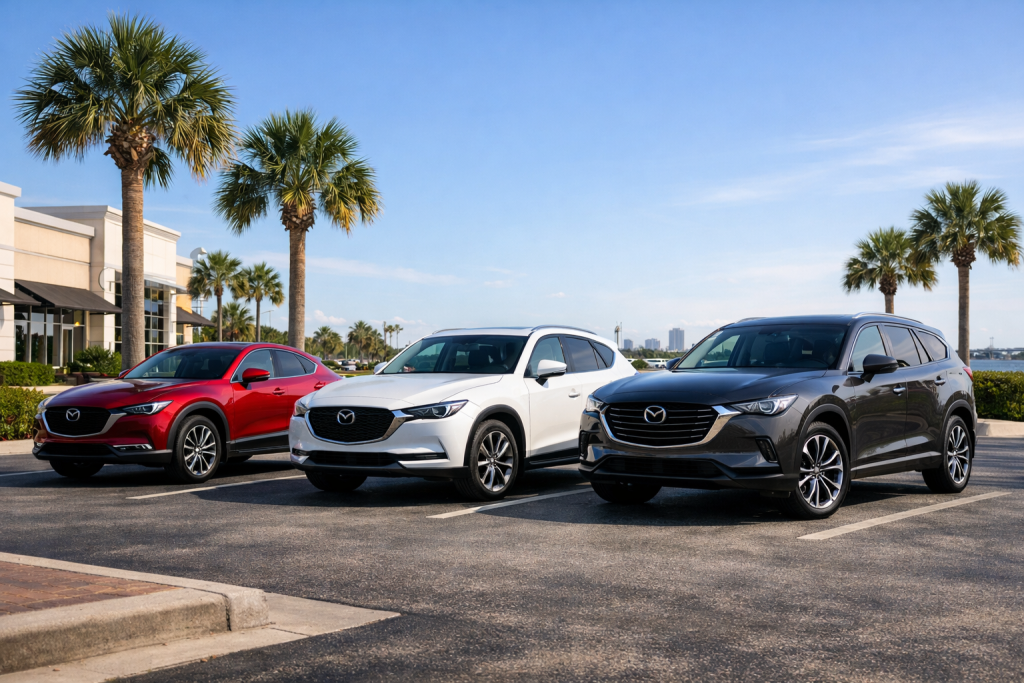
Many shoppers ask how Mazda lease payments work and why costs vary between models. A lease is built around depreciation, which is the difference between a vehicle’s starting value and its estimated value at the end of the lease term. Understanding how that depreciation interacts with vehicle size, usage, and time helps explain why different Mazda models produce different lease outcomes.
How Mazda Lease Payments Are Calculated
Drivers often want to understand what goes into a lease payment beyond the monthly number. A lease payment is primarily based on how much value the vehicle is expected to lose over the lease term, along with financing costs and any applicable fees.
The Mazda CX-5 lease structure, for example, calculates payment using three key components:
- Depreciation, which is the difference between the vehicle’s price and its projected value at the end of the lease
- Residual value, which represents that projected end-of-term value
- Money factor, which is the financing component applied to the lease
Depreciation makes up the largest portion of the monthly payment. A vehicle that holds its value more effectively will typically have a lower depreciation cost, which can reduce the monthly payment even if the starting price is higher.
For Jacksonville drivers, this means lease pricing is not just about MSRP. It is about how the vehicle is expected to perform over time.
Residual Value and How It Differs Between CX-30 CX-5 and CX-90
Shoppers frequently ask what residual value means and how it affects lease pricing. Residual value is the estimated worth of the vehicle at the end of the lease term, expressed as a percentage of its original price.
The Mazda CX-30 lease often benefits from a lower starting price and competitive residual value, making it an accessible option for drivers focused on lower monthly payments.
The Mazda CX-5 lease balances price and demand. As a popular compact SUV, it often maintains strong residual value, which can help offset its higher starting cost compared to the CX-30.
The Mazda CX-90 lease reflects its position as a larger, three-row SUV. While it offers more space and capability, the higher initial price means depreciation typically results in a higher monthly payment compared to smaller models.
For drivers comparing these vehicles, the key takeaway is that lease cost differences are driven by both starting price and how well each model is expected to retain value over time.
Mileage Limits and Real World Driving Considerations
One of the most common lease questions involves mileage limits and how to choose the right option. Lease agreements typically include annual mileage allowances such as 10,000, 12,000, or 15,000 miles per year.
Mileage limits directly affect lease cost because higher mileage reduces the vehicle’s projected value at the end of the lease. Selecting a higher mileage allowance increases the monthly payment, while selecting a lower allowance can reduce it.
For Jacksonville drivers, choosing the right mileage depends on daily driving patterns:
- Short commutes and local driving may fit within lower mileage limits
- Frequent highway travel or longer commutes may require higher allowances
- Weekend trips and regional travel should be factored into annual estimates
Exceeding the mileage limit can result in additional costs at the end of the lease, so it is important to align the allowance with actual driving habits.
Lease Term Structure and Warranty Alignment
Drivers often ask how lease length affects overall cost and ownership experience. Most Mazda leases are structured around terms such as 24, 36, or 48 months.
The Mazda CX-5 lease and other Mazda models are typically aligned with factory warranty coverage. This means that during most lease terms, major repairs are covered, reducing unexpected ownership costs.
Shorter lease terms generally result in higher monthly payments because depreciation is spread over fewer months. Longer terms may reduce monthly cost but extend the time the driver is committed to the vehicle.
For Jacksonville drivers, this alignment between lease term and warranty coverage provides a more predictable ownership experience, where maintenance and repair concerns are minimized during the lease period.
Choosing the Right Mazda Model for Your Lease Strategy
Many buyers comparing the Mazda CX-30, CX-5, and CX-90 want to know which model makes the most sense to lease. The answer depends on how each vehicle fits both driving needs and financial priorities.
The Mazda CX-30 lease is often well suited for drivers prioritizing efficiency, lower monthly payments, and ease of use in urban environments. Its smaller size and lower cost make it a practical option for commuting and daily driving.
The Mazda CX-5 lease offers a balance between cost and versatility. It provides additional space and capability while maintaining manageable lease payments, making it a strong option for drivers who need flexibility without moving into a larger vehicle segment.
The Mazda CX-90 lease is designed for drivers who require more passenger space and cargo capacity. While the monthly cost is typically higher, it aligns with the needs of families or drivers who prioritize interior space and capability.
When comparing these models, drivers should evaluate:
- Monthly payment in relation to budget
- Space requirements for passengers and cargo
- Driving patterns and mileage needs
- Length of time they plan to keep the vehicle
Leasing is not just about selecting a vehicle. It is about selecting the right structure for how that vehicle will be used.
Mazda leasing provides flexibility by allowing drivers to match a vehicle to their current needs without long term ownership commitment. By understanding how lease payments are calculated, how residual value affects cost, and how different models align with specific driving patterns, Jacksonville drivers can make more informed decisions when comparing the CX-30, CX-5, and CX-90.
Connect with us


