

The 2026 Mazda MX-5 Miata vs Mazda3 Hatchback comparison is not a contest between a sports car and a sensible compact. Both vehicles carry Mazda’s core engineering philosophy. Both reward a driver who pays attention. However, they deliver that reward through entirely different mechanical approaches. Understanding what each chassis actually does changes how clearly a driver can evaluate which one fits the way they drive.
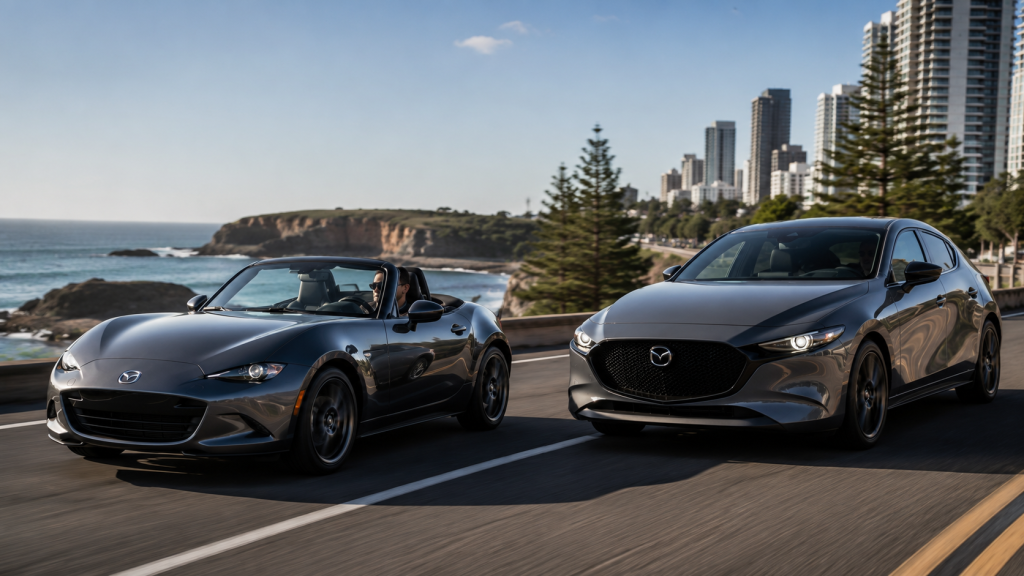
How the Two Chassis Architectures Create Different Engagement
Drivetrain layout shapes how a car communicates with its driver more than almost any other single factor. The MX-5 Miata uses a rear-wheel drive layout. The Mazda3 Hatchback uses front-wheel drive, with i-Activ AWD available on upper trims.
In a front-wheel drive vehicle, the front tires handle both steering and power delivery at the same time. Under hard acceleration, weight transfers rearward and reduces load on the front axle. That shift creates a mild tug through the steering wheel as the front tires work against the competing demands of turning and driving. The Mazda3’s engineers address this through precise chassis tuning and the available AWD system, which distributes torque across all four corners and reduces that front-axle conflict considerably.
The MX-5 separates those demands entirely. The front tires steer. The rear tires drive. That division allows each axle to do one job cleanly. Moreover, the rear-drive layout allows the driver to use throttle input to influence the car’s cornering attitude in ways a front-drive platform cannot replicate. A driver who trails the throttle into a corner in the MX-5 shifts weight forward, loads the front tires, and sharpens turn-in. That communication runs through the steering wheel, the seat, and the pedals simultaneously. It is the mechanical definition of Jinba Ittai at the chassis level.
What the MX-5 Miata’s Lightweight Platform Delivers
The 2026 MX-5 Miata soft top weighs approximately 2,366 lbs. That number drives the engagement model more than the 181 hp engine does. Low mass changes the felt intensity of every input. A throttle press, a steering correction, a braking point reached slightly late each produces a more immediate and more communicative response than the same input would in a heavier vehicle.
The near 50/50 front-to-rear weight distribution reinforces this. Weight sits balanced across both axles at rest. Through a corner, neither end carries disproportionate load. As a result, the car rotates predictably and the driver can place it with confidence.
The following specifications define the MX-5’s engagement architecture in concrete terms:caranddriver+1
- At approximately 2,366 lbs, the soft top MX-5 produces roughly 76 hp per 1,000 lbs of vehicle weight, which places it among the highest power-to-weight ratios in its price class and explains why 181 hp feels far more alive in this chassis than the same output would in a heavier car.
- The near 50/50 weight distribution means the front and rear axles carry roughly equal load at rest, which allows the suspension to work symmetrically through direction changes and gives the driver consistent feedback from both ends of the car at the same time.
- The short 90.9-inch wheelbase concentrates the vehicle’s mass close to the center of the car, reducing rotational inertia and allowing the chassis to change direction with a quickness that longer-wheelbase vehicles cannot produce regardless of their power output.
The RF adds a retractable fastback roof and approximately 100 lbs over the soft top. That modest weight increase preserves nearly all of the soft top’s engagement character while adding weather insulation and a quieter cabin at highway speeds.
What Does the Mazda3 Hatchback Bring to the Engagement Conversation?
The Mazda3 Hatchback is not a car that asks its driver to compromise between engagement and usability. It is a car that delivers both on the same trip. The standard 2.5-liter naturally aspirated engine produces 191 hp. That output moves the Mazda3 with genuine confidence on a two-lane road or a highway on-ramp.
The turbocharged variant changes the conversation further. The 2.5-liter turbo produces 250 hp and 320 lb-ft of torque. Paired with i-Activ AWD, it reaches 60 mph in under six seconds. That performance envelope puts the Mazda3 Turbo in legitimate sports compact territory. However, it delivers that performance without the MX-5’s physical involvement. The AWD system manages traction distribution electronically. The chassis isolates the driver from the road texture that the MX-5 transmits directly through its structure.
How the Mazda3 Hatchback Earns Its Engagement Credentials
The Mazda3’s engagement comes from a different source than the Miata’s. Its steering is precise and well-weighted. The suspension tuning produces a composed, planted feel through corners without the stiffness that often comes with sporty compact setups. G-Vectoring Control runs continuously, making micro-torque adjustments at turn-in that keep weight loaded on the front tires through corners. Beyond that, the 2026 model year refines the cabin materials and driving position further, tightening the connection between driver and car in the way Mazda consistently prioritizes across the lineup.
How Jinba Ittai Applies Differently to Each Vehicle
Jinba Ittai translates roughly as oneness between horse and rider. Mazda applies it as an engineering target, not a marketing phrase. The goal is a vehicle that responds so naturally to driver inputs that the boundary between person and machine becomes difficult to locate. Both the MX-5 and the Mazda3 pursue that target. They reach it through different paths.
The MX-5 pursues Jinba Ittai through physical directness. Low mass reduces the inertia between input and response. Rear-wheel drive separates steering and power delivery so each communicates cleanly. The short wheelbase and balanced weight distribution make the car rotate around the driver rather than requiring the driver to manage a larger, heavier chassis. Every mechanical choice prioritizes the intensity of the connection over the breadth of the car’s capabilities.
The Mazda3 pursues the same target through refinement and precision. Its steering communicates road surface and cornering load without amplifying harshness. The chassis absorbs road irregularities and returns a stable, predictable platform that a driver can push with confidence. G-Vectoring Control adds a layer of weight-transfer management that makes the car feel more balanced than its front-drive layout would suggest without it. The result is a car where the driver feels competent and in control rather than physically immersed in the road.
Neither expression is a lesser version of the other. They reflect two genuinely different answers to the same engineering question.
Which Vehicle Fits Which Driver
The right choice between these two comes down to how a driver weighs engagement intensity against daily versatility. Both cars reward attention. They reward it differently and they ask different things in return.
A driver who prioritizes the physical experience of driving above most other factors, who takes two-lane roads deliberately, and who can manage a two-seat cabin and minimal cargo space in daily life will find the MX-5 irreplaceable. No car at its price point delivers the same level of chassis communication, weight distribution purity, and driver involvement. That experience has a real cost in practicality.
A driver who wants genuine driving satisfaction on every commute, the flexibility to carry passengers and cargo, and the option of turbocharged AWD performance in a refined and comfortable daily package will find the Mazda3 Hatchback a more complete answer. It does not provide the MX-5’s physical intensity. However, it provides daily engagement without requiring the driver to plan around the limitations of a two-seat roadster.
The following questions help clarify which vehicle serves a given driver better:
- If the driver regularly carries more than one passenger, needs cargo space beyond a weekend bag, or lives in a region with significant winter weather and no secondary vehicle, the Mazda3 Hatchback with i-Activ AWD serves those needs without sacrificing driving engagement on roads that reward a well-tuned compact.
- If the driver primarily commutes solo, values the physical sensation of driving above passenger comfort or cargo room, and treats backroads and weekend routes as a priority rather than an occasional bonus, the MX-5 Miata delivers an experience that no other vehicle in the Mazda lineup can replicate at any price.
Both the MX-5 and the Mazda3 Hatchback represent Mazda’s commitment to building cars that move the driver, not just the passengers. The difference is the form that movement takes. One puts the road in your hands. The other puts it beneath your feet. Knowing which sensation you want is the most honest way to choose between them.
Connect with us


Recent Blog Entries
- 2026 Mazda MX-5 Miata vs Mazda3 Hatchback: Driving Engagement Compared
- Mazda Drive Modes Explained: Efficiency, Comfort, and Control
- Mazda OEM Battery Replacement vs Aftermarket: Longevity Explained
- Mazda Multi-Point Inspection: What Gets Checked and Why It Matters
- CX 5 vs CX 50 Hybrid: Efficiency, Space, Driving Feel