

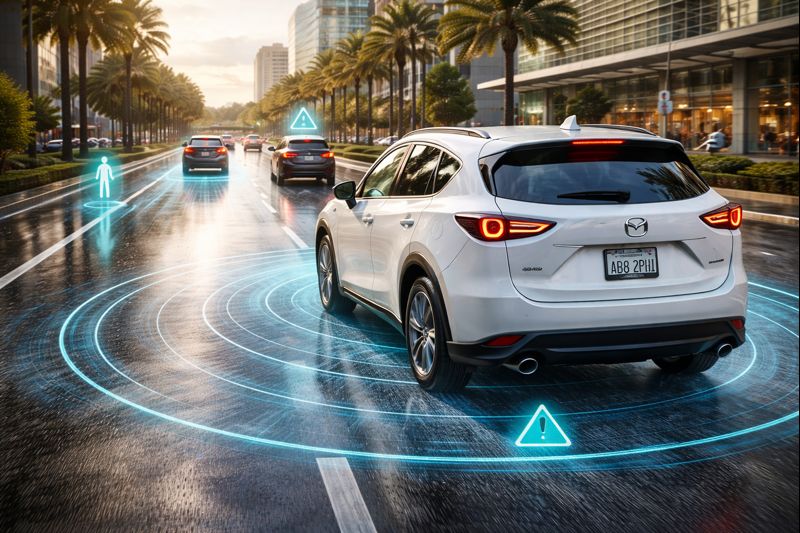
Mazda approaches safety as an extension of how a vehicle should feel to drive. Rather than layering automation on top of the driving experience, Mazda designs safety systems to work quietly in support of driver awareness, balance, and control. i-Activsense represents this philosophy in practice. It is not a single feature, but a coordinated suite of technologies engineered to help drivers recognize potential hazards earlier and respond more naturally.
For Orange Park drivers navigating suburban traffic, highway corridors, sudden rainstorms, and everyday commuting, understanding how i-Activsense works explains why Mazda vehicles feel reassuring without feeling overbearing.
What Mazda i-Activsense Really Is
i-Activsense is Mazda’s umbrella term for its active safety and driver assistance technologies. These systems are designed to complement human perception rather than replace it.
Core elements of i-Activsense include:
- Forward facing cameras that monitor vehicles pedestrians and lane markings
- Radar sensors that track distance and relative speed
- Vehicle control modules that analyze movement and driver input
- Brake steering and powertrain interfaces that allow measured intervention
Instead of reacting only when a situation becomes critical, i-Activsense systems operate continuously to support situational awareness.
A Human-Centric Safety Philosophy
Mazda designs safety systems around the idea that drivers should remain engaged and informed. Alerts and interventions are calibrated to feel intuitive rather than abrupt.
This philosophy prioritizes:
- Early awareness over last second intervention
- Smooth responses instead of aggressive corrections
- Clear communication rather than constant warnings
- Driver confidence rather than dependence on automation
As a result, i-Activsense systems feel like a natural extension of the vehicle rather than a separate layer of technology.
Smart Brake Support and Collision Mitigation
Mazda Smart Brake Support is designed to help reduce the severity of frontal collisions or avoid them altogether when possible. The system monitors the road ahead and provides escalating alerts as risk increases.
Key characteristics include:
- Visual and audible warnings that prompt driver action
- Brake assistance when the driver begins braking
- Automatic braking if the driver does not respond in time
- Smooth braking application designed to maintain vehicle stability
This graduated approach allows drivers to remain in control while receiving timely support.
Blind Spot Monitoring and Rear Cross Traffic Awareness
Blind spot monitoring addresses one of the most common real world driving challenges: detecting vehicles approaching from adjacent lanes.
Mazda’s approach includes:
- Radar sensors that track vehicles alongside and behind
- Visual alerts positioned where drivers naturally look
- Rear cross traffic monitoring when reversing
- Alerts calibrated to reduce unnecessary warnings in dense traffic
For Orange Park drivers dealing with busy parking lots and multi lane roads, these systems enhance awareness without distraction.
Lane Departure and Lane Keeping Support
Mazda lane related safety systems are designed to guide rather than force. Cameras monitor lane markings and evaluate steering input to determine when assistance is appropriate.
Lane support features include:
- Lane departure warnings when unintentional drifting is detected
- Gentle steering assistance to guide the vehicle back into the lane
- System behavior that respects intentional lane changes
- Calibration that prioritizes subtle corrections
This approach supports alert driving rather than replacing it.
Adaptive Cruise Control and Traffic Flow Support
Adaptive cruise control helps maintain a set distance from vehicles ahead while adjusting speed smoothly. Mazda tunes this system to reflect natural driving behavior rather than abrupt acceleration or braking.
System benefits include:
- Gradual speed adjustments that reduce driver fatigue
- Consistent following distance in varying traffic
- Smooth operation in stop and go conditions
- Integration with other safety systems for stability
This is particularly useful for drivers spending extended time on highways or in congested areas.
How Chassis Engineering Enhances Safety Behavior
Mazda’s safety systems work in harmony with the vehicle’s chassis and suspension tuning. Predictable vehicle behavior allows electronic systems to operate smoothly and effectively.
Chassis related contributions include:
- Balanced weight distribution that supports stable braking
- Suspension tuning that maintains tire contact with the road
- Steering feedback that keeps the driver informed
- Predictable responses during corrective maneuvers
Because the vehicle itself behaves consistently, safety interventions can remain subtle.
i-Activsense in Wet and Changing Conditions
Florida weather can change quickly. Sudden rain and slick roads place additional demands on both driver and vehicle.
i-Activsense supports wet weather driving by:
- Monitoring traction changes through sensor input
- Supporting controlled braking and acceleration
- Enhancing awareness when visibility is reduced
- Helping maintain stability during unexpected situations
This is where predictive safety design becomes most noticeable.
Standardization and Accessibility Across Mazda Models
Mazda emphasizes making safety technology widely available rather than reserving it for top trims. Many i-Activsense features are standard or broadly accessible across Mazda sedans and SUVs.
This approach reflects Mazda’s belief that safety should be inherent, not optional.
What Drivers Should Evaluate When Considering Safety Technology
When evaluating safety systems, shoppers should look beyond feature lists.
Important considerations include:
- How naturally alerts are delivered
- Whether interventions feel smooth or abrupt
- How well systems integrate with vehicle handling
- Whether the technology supports confidence rather than distraction
i-Activsense is designed to score well in real world use rather than on paper alone.
Final Perspective on Mazda i-Activsense
Mazda’s i-Activsense demonstrates how safety technology can enhance driving without diminishing it. By focusing on awareness, predictability, and subtle support, Mazda creates systems that help drivers feel more confident in everyday situations.
For Orange Park drivers who value intuitive control and reassurance rather than heavy handed automation, i-Activsense delivers safety engineering that feels thoughtful, balanced, and aligned with how people actually drive.
Connect with us


Recent Blog Entries
- 2026 Mazda MX-5 Miata vs Mazda3 Hatchback: Driving Engagement Compared
- Mazda Drive Modes Explained: Efficiency, Comfort, and Control
- Mazda OEM Battery Replacement vs Aftermarket: Longevity Explained
- Mazda Multi-Point Inspection: What Gets Checked and Why It Matters
- CX 5 vs CX 50 Hybrid: Efficiency, Space, Driving Feel